

Joe Fucigna
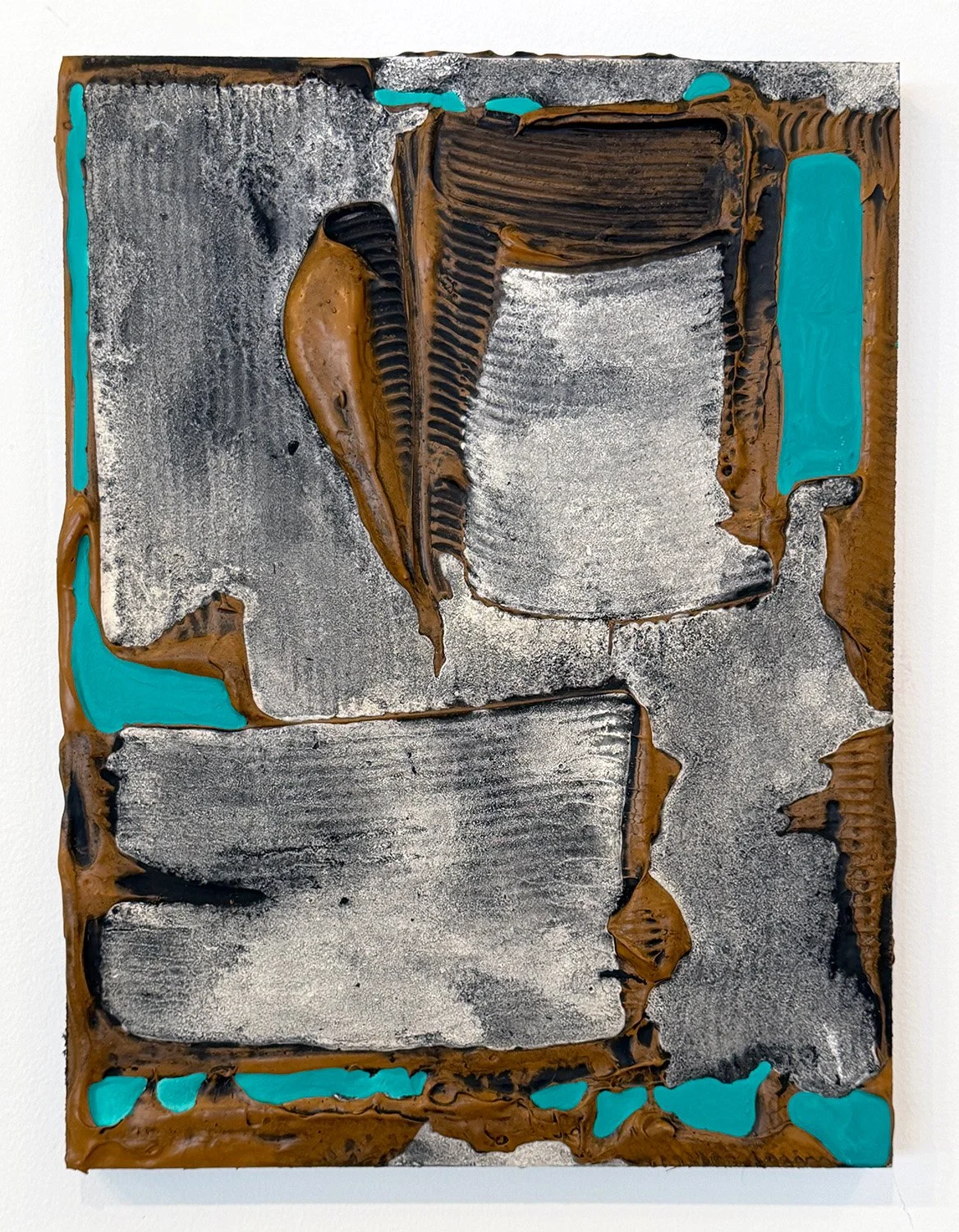
Excavated Fields 1, 2026, acrylic, clay slurry, 16 × 12 × 1”
MS: You grew up in Connecticut, right?
JF: Yeah, I grew up in Norwalk. Outside of school, I haven't moved too far from the nest. I've stayed in this area because it suits me. I tried moving to New York City, but doing steel sculpture back then was difficult—you needed space, and space wasn't easy to come by.
I like living here because I have roots. You're close to the water, close to the city, close to the country, and, at the time, it was still affordable. Add family to that, and I've never really had a reason to leave.
I went to Alfred University for art school. It was one of the few schools that accepted me after I didn't do particularly well in high school. They had a strong ceramics program, and I'd enjoyed ceramics, so that's what drew me there. Once I arrived, though, I fell in love with steel sculpture.
When I graduated in 1979, my goal was simple: build a studio, make work, exhibit, and see if I could make a life as an artist. I spent the next five years doing exactly that.
MS: What did those first years look like?
JF: I wanted to support myself, keep a studio, and find out whether I truly wanted this life. I always tell students that going straight from undergraduate to graduate school can sometimes postpone that question. Eventually you still have to discover whether you love being an artist or simply the idea of being one.
Those five years answered it for me.
During that time I attended the Triangle Workshop in Pine Plains, New York, where Anthony Caro, Clement Greenberg, and a remarkable group of artists and critics spent two weeks making sculpture together. It changed my work almost immediately.
By then I'd been working in steel for seven or eight years, and I felt boxed in by the tradition. I wanted to move beyond scrap steel and see where the work naturally wanted to go. That experience convinced me I was ready for graduate school, so I enrolled at the School of Visual Arts from 1986 to 1988.
Graduate school did exactly what I'd hoped. I left steel behind and began working with much common industrial materials that were easier to work with. One of my first bodies of work used truck tire inner tubes, which I cut and manipulated into sculpture. I came out feeling like a different artist.
The other reason I pursued an MFA was because I wanted to teach.
MS: Sure, I understand that. Something you said earlier really resonated with me—about taking time between undergraduate and graduate school. If I could do it again, I probably would have done the same.
My mentors encouraged me to spend a few years developing my work before applying to graduate school, but I worried that if I waited, life would pull me in another direction. Instead, I ended up confronting those same questions after graduate school. Once the structure disappears, you have to figure out how to build a life as an artist.
That makes me wonder about your own beginnings. Did you grow up in a family where art was important, or did you discover it on your own?
JF: Creativity was definitely present and encouraged in my family, especially on my father's side, although they weren't artists. My father loved gardening and other creative outlets. If there was a project around the house, he was interested.
My parents weren't the kind who enrolled us in art classes or carefully guided our interests. We were baby boomers—they mostly let us figure things out ourselves.
My mother is ninety-six now, and she still says, "I always felt like we didn't give you kids much direction." Honestly, I think that freedom was a gift. We learned by exploring.
I also didn't come through art in the traditional way. A lot of artists begin by learning to draw realistically and get rewarded for it. That wasn't my experience. I took art classes in school, but they were fairly unstructured. It was mostly, "Here's the material—go make something."
Looking back, that's probably why I've always been comfortable finding my own path.
My older sister was interested in art, and I remember watching her take classes. That probably sparked something.
MS: I like what you said about having the freedom to explore. I grew up outside Eugene, Oregon, in a rural area. My mom was a gardener, and there was always a do-it-yourself attitude around the house.
As a kid I'd wander around collecting scraps, inventing projects, and figuring things out on my own. Looking back, I'm grateful for that because I think boredom and limited resources encourage creativity.
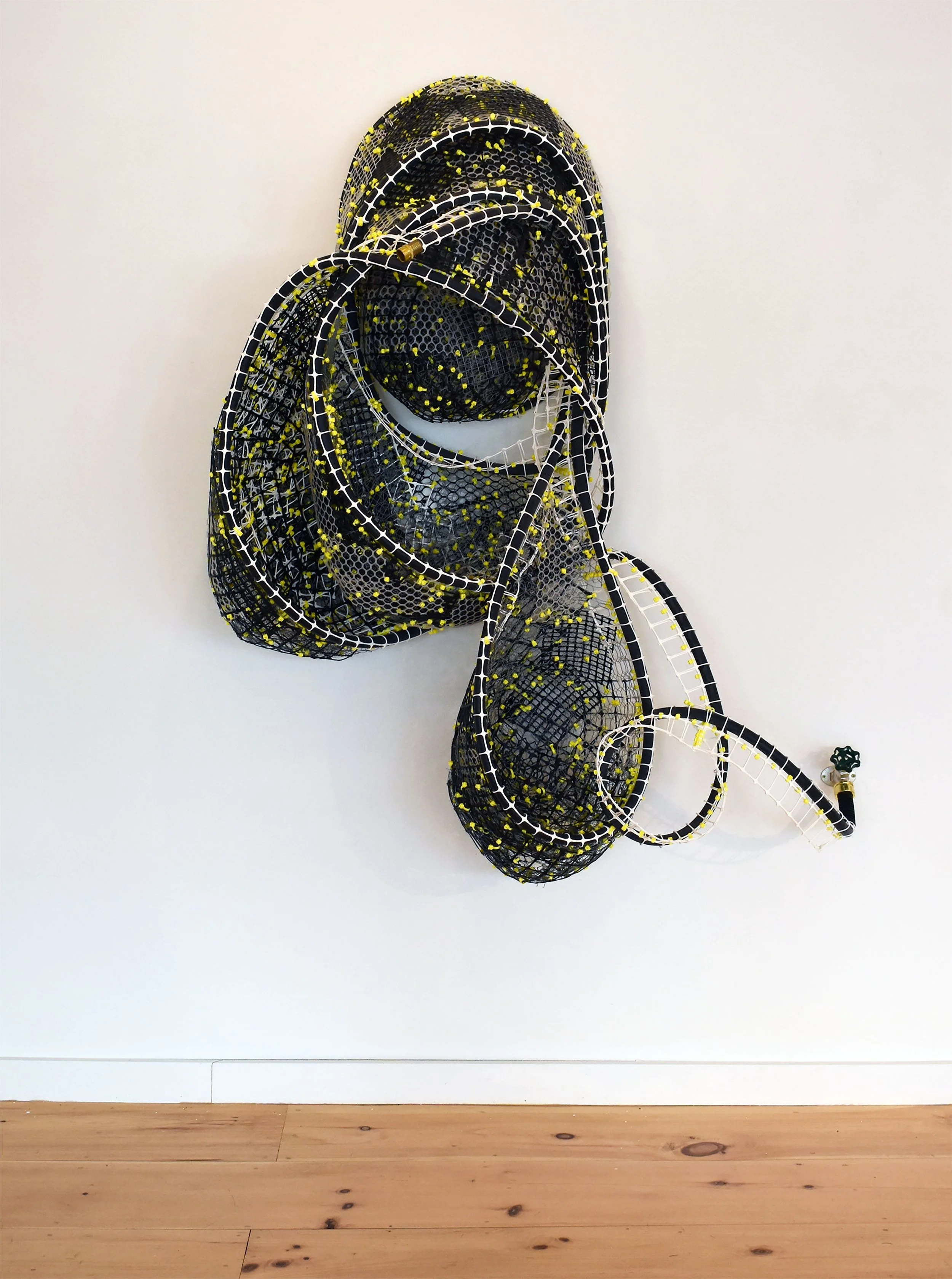
Black Hose #3_black_white_yellow, 2020, plastic and metal fencing, rubber hose, 60 x 36 x 12”
JF: I completely agree.
When I was in elementary school they gave an artistic aptitude test, and because it focused on drawing, I didn't get into the advanced art program. Later, in middle school, a guidance counselor pulled me aside after another series of aptitude tests and told me my spatial reasoning scores were off the charts.
That made perfect sense. I was always a builder.
We grew up in one of the last big housing developments built in Norwalk. There were kids everywhere and woods all around us. We built tree houses, underground forts, rock forts—we were constantly making things with our hands.
That's probably why I've always thought drawing and sculpture attract different personalities. Drawing often appeals to quieter, more introspective people who enjoy working alone. That wasn't me.
I always had too much energy. Looking back, I probably had undiagnosed ADHD. I wanted to build things, move around, and work physically. In hindsight, I was already making sculpture in middle school—I just didn't know to call it that.
Around the same time I started looking at art magazines and became fascinated by Picasso. I even made two life-size figures out of chicken wire for a school project. When I think about it now, it's remarkable that I was making life-size sculpture at that age.
MS: That's ambitious for any middle school student.
I'm interested in something you mentioned—that drawing can be private while sculpture is inherently more public. Building something in space naturally attracts people. It becomes a shared activity.
JF: I think that's true, and it reflects how I grew up. Everything was physical.
It's one of the biggest changes I see in students today. Many arrive with very little experience using their hands—not because they've done anything wrong, but because they simply haven't had those opportunities. When I teach, I no longer assume students know how to use a ruler, a tape measure, or a utility knife.
I've also spent a lot of time thinking about how I learn. I don't like following directions. My wife is wonderful at reading instructions. I'm exactly the opposite. I've always preferred learning through making.
That's another reason abstraction appealed to me. Traditional academic drawing often begins with a structured sequence of techniques. I was never interested in that. I've worked abstractly from the beginning.
Most young artists are rewarded for making convincing representations. I was drawn to abstraction because it offered freedom. It gave me room to discover things instead of simply reproducing them.
That's also why I've never been interested in commercial work or commissions. I don't enjoy making someone else's vision. I want the work to evolve through the act of making.
MS: You mentioned discovering artists through magazines. I remember a similar experience. My family wasn't especially interested in contemporary art, so when I found artists like Picasso and Pollock as a teenager, it felt like my own independent discovery.
JF: And that's probably a good thing.
Living in Connecticut, I was fortunate to be close to New York. I could visit museums, see major exhibitions, and gradually become aware of what artists were doing beyond my own studio. That exposure made a tremendous difference.
JF: During those years between undergraduate and graduate school, I taught at Silvermine. That experience gave me confidence in the classroom and confirmed that teaching was something I genuinely enjoyed.
When I finished SVA, I was married and had a young child. Since I'd kept my studio in Norwalk and commuted into New York, graduating wasn't a major disruption. I went back to the studio and focused on finding a full-time teaching position.
Like anyone who's gone through that process knows, it was competitive. I picked up a few teaching jobs before landing an adjunct position at Norwalk Community College in 1988.
Ironically, they hired me to teach drawing, which was probably my weakest subject. But I was grateful for the opportunity. Ann Chernow, who was there at the time, became one of the most influential people in my teaching career. She encouraged me and helped me grow as an educator.
I gradually built up my teaching experience. At one point I spent a year as a half-time lecturer at Stony Brook. You sometimes think the grass is greener at a larger university, but it wasn't for me. The facilities were wonderful, but the politics were exhausting. I actually found the students at Norwalk Community College more engaged.
Ann Chernow assumed I might leave, so she pushed hard for me to get a full-time position at NCC. That's how I ended up staying.
I've now finished my thirty-seventh year there, so I've been very fortunate.
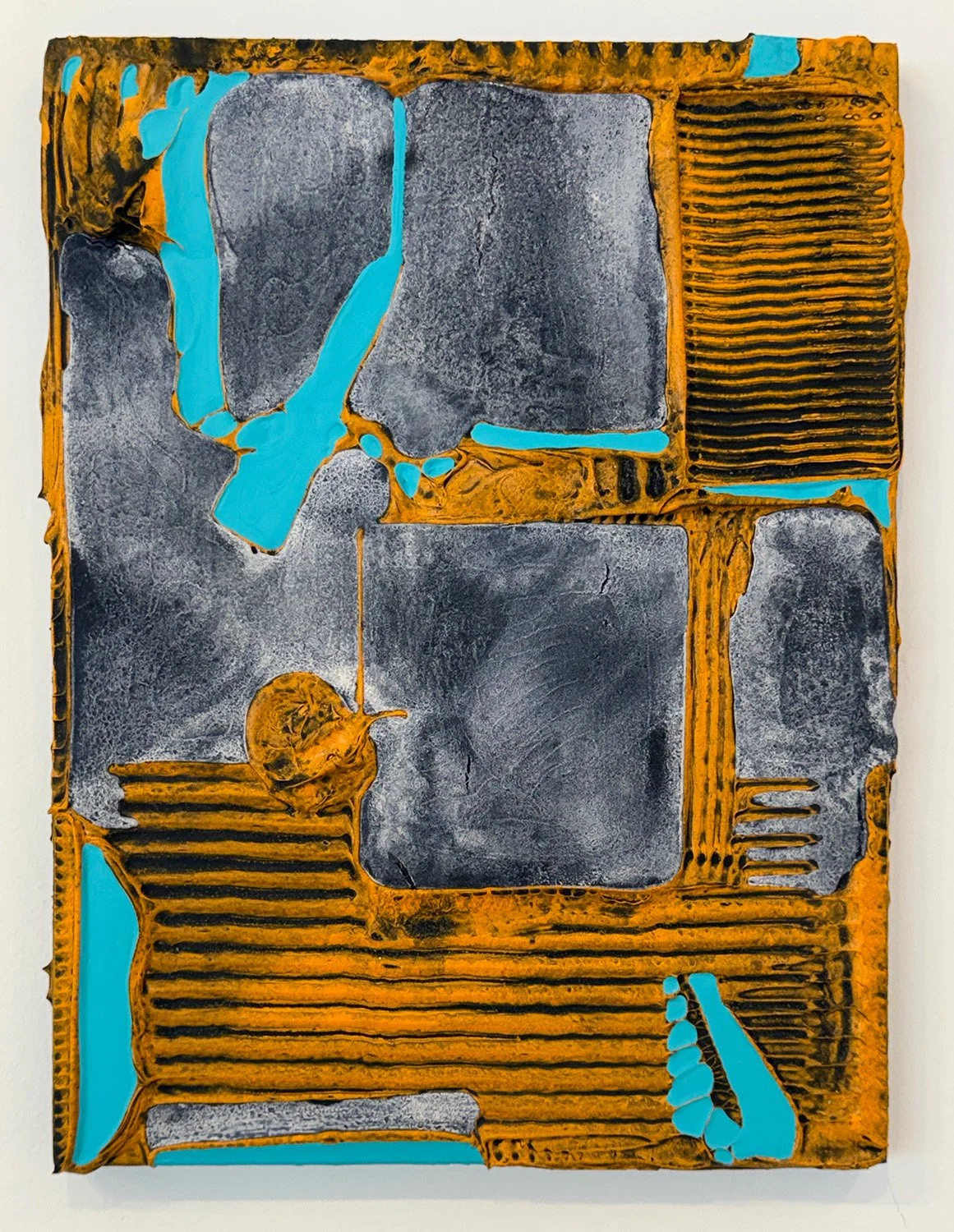
Excavated Fields 2, 2026, acrylic, clay slurry, 16 × 12 × 1”
MS: Congratulations. That's an incredible run at one institution.
I'd like to go back for a moment. Between finishing Alfred and starting graduate school, were you doing any commercial metal fabrication?
JF: No. I tried a little, but it was never what I wanted to do.
MS: So no industrial welding or fabrication?
JF: No. My setup was pretty modest—a stick welder, a few grinders, and that's about it. I've always preferred keeping things simple.
I rented studio space in the old Yale & Towne industrial complex in Stamford. It was a wonderful building, and Rubino Brothers scrapyard was right down the street. I'd collect steel, make sculpture, load everything into my truck, and haul it wherever it needed to go. It was a good life.
MS: How were you supporting yourself then?
JF: I waited tables, which turned out to be perfect because I worked nights. That left my days for the studio.
I always tell students there's a huge difference between working all day and trying to make art afterward versus making your artwork the priority and your paycheck second. Working evenings let me put my best energy into the studio.
Money was always tight. I taught when opportunities came up, worked in restaurants, lived with roommates, and did whatever I had to do. But I supported myself, kept a studio, and continued making work.
Looking back, I worked constantly during those years, and I remember them very fondly.
MS: When you first started looking through those art magazines, were there particular artists who made you think, This is something I want to be part of?
JF: The Abstract Expressionists had a huge impact on me. That movement was everywhere when I was growing up, and I was immediately drawn to it because it embraced abstraction.
Pollock, especially, has always been important to me. Even when I teach art appreciation, I come back to his work because there's so much happening there—not just visually, but philosophically.
I also remember taking a school trip to the Metropolitan Museum when they were showing an early Pop Art exhibition. Seeing Warhol's Brillo Boxes was unforgettable. It didn't change the direction of my work, but it expanded my understanding of what art could be.
Louise Nevelson was another major influence. I remember hearing she had a show at Pace Gallery that was about to close, so I took the train into New York just to see it.
MS: How old were you?
JF: Probably high school—maybe early college. What stands out isn't even the exhibition itself so much as the fact that I felt compelled to make that trip. Looking back, I realize how important art had already become to me.
I wasn't interested in comic books or superheroes. Somehow I kept finding art magazines and paying attention to contemporary artists. That's where my curiosity was.
MS: Was being so close to New York ever intimidating?
I sometimes think I benefited from growing up in Oregon because there was a certain innocence to it. I wasn't constantly comparing myself to the contemporary art world. By the time I finally encountered it in person, I already had enough momentum in my own practice that it felt inspiring more than overwhelming.
JF: Not really. For me, New York was simply part of the landscape.
There are advantages to being isolated—you have to invent things for yourself—but being close to New York allowed me to see artists like Louise Nevelson and realize something that became fundamental to my own practice: you can make art out of anything.
That idea changed everything. I've never been interested in traditional sculpture—modeling clay for bronze or carving stone. I was always more interested in constructing things from ordinary materials.
Picasso reinforced that idea, and later David Smith and Anthony Caro became important influences. Eventually I even had the opportunity to work with Caro, which was extraordinary.
Looking back, I realize those interests have remained remarkably consistent. The materials have changed, but the underlying questions haven't.
I tell my students; everyone has a planet where they're comfortable. Every so often you have to leave that planet and visit what I call the ugly planet—the place where nothing works, everything feels awkward, and you're completely unsure of yourself.
Eventually you come back home. But when you do, your planet is bigger than it was before. You have to be willing to visit that uncomfortable place if you want to grow.
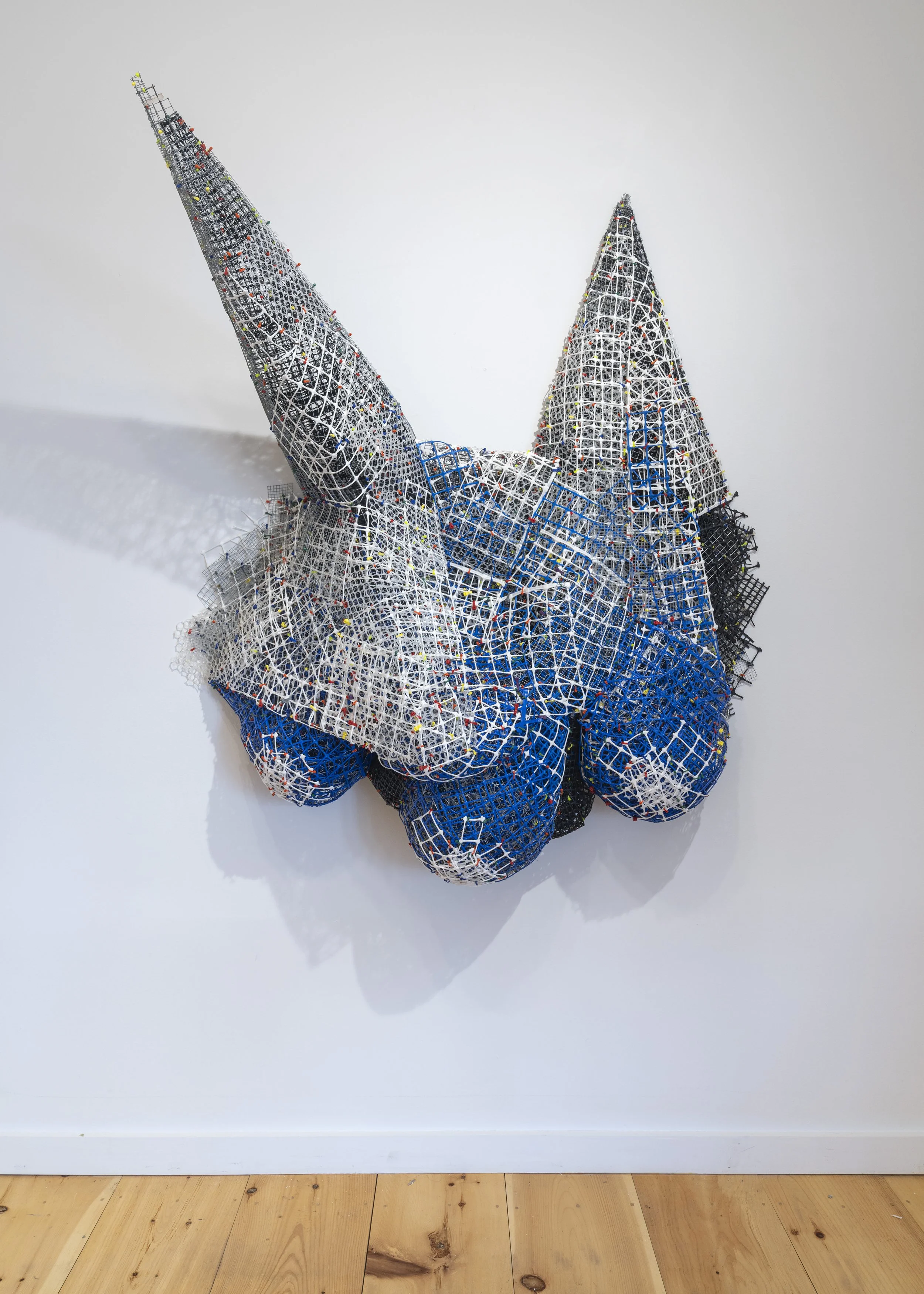
Cubist Drapery white blue black, 2021, Plastic and metal fencing, 60 x 52 x 27”
MS: What about the Triangle Workshop. You mentioned it as a turning point. What actually happened there?
JF: It was an extraordinary experience.
Imagine making sculpture in a barn with Anthony Caro while Clement Greenberg walks in and starts looking at your work. At one point Caro challenged something I was doing, and Greenberg, almost in passing, seemed to support my decision. I remember thinking, Wow. Those were giants.
I didn't go there expecting to change my work. I simply wanted two weeks of making sculpture with serious artists. It was the first time since undergraduate school that I'd been back in an intensive learning environment.
But something shifted. Caro was wonderfully direct. At one point he told me my work had become too crafty—that I was relying too much on technique. That comment stayed with me.
At the time my sculpture was becoming increasingly formal and closely aligned with Caro's own tradition. During the workshop I pushed even further in that direction.
Then I came home. Within days, an entirely different body of work emerged. Four or five pieces appeared almost immediately, unlike anything I'd made before. That's when I knew I was ready for graduate school. Not because I wanted another degree, but because I was ready to challenge myself again.
By then I'd already learned how to make sculpture. What I needed was permission to leave behind what I knew. Graduate school gave me exactly that.
No one told me what to make. They challenged me, encouraged me, and allowed me to work through a long period of uncertainty until another direction emerged.
Looking back, that willingness to embrace uncertainty has shaped everything I've done since.
MS: You've talked about graduate school as a moment of transformation. I'm curious how that willingness to reinvent yourself has continued throughout your career.
JF: My work has always been driven by materials.
I'll find an ordinary industrial material—something anonymous or overlooked—and spend time discovering what makes it unique. I learn what it wants to do, what it resists, and what possibilities it contains. Only then do I begin building a body of work around it.
Clay came first. Then steel. Graduate school led me to rubber.
Later I experimented with fiberglass and resin, although I never really enjoyed those materials.
For the last twenty years or so I've worked extensively with plastic fencing, cable ties, and related industrial materials.
Then, about three years ago, everything changed. A close friend passed away, and I was asked to clean out his studio. Suddenly I was deciding what would happen to another artist's life's work—which pieces would be kept and which would be discarded. That experience affected me deeply.
At the same time, I was getting older and asking myself the same question every artist eventually faces:
What happens to all this work?
There was also the physical reality. After decades of making sculpture with cable ties, my hands were beginning to give out. I developed arthritis and bone spurs in my thumb, and I realized I couldn't continue working the same way forever.
So I made a decision. I stopped making sculpture. That's still a strange sentence to say because sculpture is what people know me for. It's what I've devoted my career to. But I decided to approach the transition the same way I approached graduate school. I often joke that I've just finished my second graduate degree—only this one happened entirely in my own studio. I committed myself to making flat works.
I don't even call them paintings because I don't think of myself as a painter. I simply say I make flat works. That keeps the possibilities open. I'd always made them alongside my sculpture, but I rarely showed them. I wasn't confident enough yet.
For the last two years I've immersed myself in that work. It's been difficult—really difficult—but I've been through uncertainty before. I know what it feels like to make awkward work and keep going anyway.
Then Julie Durkin Marty invited me to have a solo exhibition in September. She and her husband Bob Marty run the Georgetown Arts and Culture Center. I realized that exhibition would become my thesis show. It gave me a deadline and a reason to fully commit to this new direction. I've been working almost nonstop, and for the first time I feel like I'm beginning to understand what these works want to become.
That could change tomorrow. But right now it feels like I've made the transition.
My goal has been simple; to become more fearless. The fear never disappears. After all these years it's still there. The challenge is learning to work anyway.
I've also deliberately started working smaller. Most of the pieces are no larger than sixteen by twenty inches. I want inexpensive materials. I want to work quickly. As soon as work becomes large, it also becomes precious. It costs more, takes longer, and demands more space.
I've already got enough large sculptures filling my studio. This feels like the right time to make something different. It's been one of the hardest transitions of my career. But I also think that's exactly how it's supposed to feel.
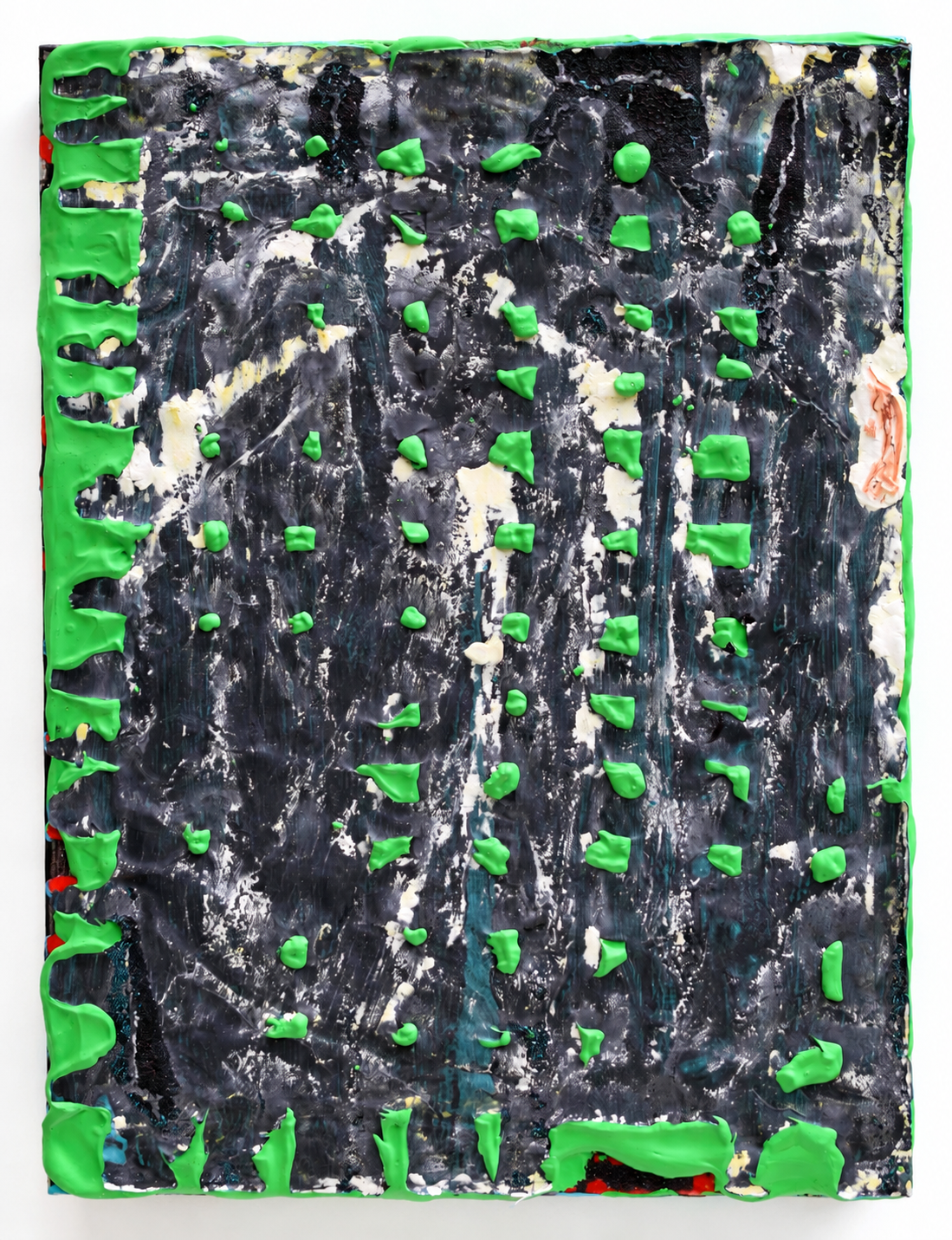
Pressed and Squeezed 1, 2024, acrylic, clay slurry
MS: What I find encouraging is that reinvention doesn't require another graduate degree. At some point you simply recognize it's time to become a beginner again.
Looking back, the biggest changes in our work often feel radical while they're happening, but years later you realize the underlying questions haven't changed at all.
JF: People imagine artists spend all their time making things, but a huge part of the work happens away from the studio bench. You live with the work. You think about it. Gradually you begin to recognize the thread connecting what you're doing now with what you were doing years ago. Those moments are deeply satisfying because you realize you've been asking the same questions all along.
That's one reason I've always been grateful that teaching supported my studio practice. I've never depended on selling artwork to pay my bills. Teaching allowed me to protect my curiosity. I never had to think of the work primarily as a product or make decisions based on what someone else wanted to buy.
That's something I tell students all the time. Find a way to support yourself that protects your studio practice. If every piece has to pay your rent, it's much harder to take risks.
I'm not a commercial artist, and I know I wouldn't be very good at it. I want the work to evolve through the process itself.
MS: I understand that completely.
I've had gallery directors tell me my work changed too much—that they weren't sure how to present me because I kept moving from one body of work to another. I understand their position, but the desire to keep exploring has always been stronger than the desire to build a predictable market.
JF: When I had gallery representation there was always a voice in the back of my mind asking, Will this sell? I hated that voice. The moment you begin making decisions based on what someone else might buy, the work changes.
MS: One thing that struck me when I visited your studio was that it didn't feel product-oriented. There were multiple pieces developing at once, different materials, different workstations. It felt like a place where ideas were being tested rather than manufactured.
That really resonated with me because I've realized there are healthy and unhealthy ways for me to work. When I become fixated on producing a finished object, every decision starts to feel precious. But when I'm immersed in the process, the work begins telling me where it wants to go.
JF: I know what you mean. Painting has taught me that in a different way than sculpture. With sculpture I could usually recognize when a piece was finished. These flat works have been much more elusive. For years I joked that I could make wonderful backgrounds but couldn't find the final element that completed the piece.
Only recently have I started breaking through that. One thing I've learned is to always leave the studio with something unfinished. Never finish everything before you go home. That way, when you come back the next day, you already have a place to begin. The worst feeling is walking into the studio, looking at one finished piece, and wondering, Now what?
I also like having several works going at once. If one stalls, I move to another. That movement keeps everything alive.
MS: I work the same way.
I often encourage students to work in multiples rather than investing everything in a single piece. If you make five versions of something, you lean much more and there isn’t so much pressure riding on a single piece. As you make multiples, you build knowledge with each attempt, and that definitely adds up to a more satisfying body of work.
Even if the strongest piece in a series comes together in fifteen minutes, it carries the momentum of all the experiments and failures that came before it.
People always ask how long a finished piece took. The honest answer is that it's almost impossible to say.
JF: Definitely. Some of these flat works have sat in my studio for five years before I knew what they needed.
I'll move them around, put them away, bring them back out, and then one day another piece suddenly reveals the missing element. Those moments can't be forced. They have to be discovered.
MS: I've noticed something similar.
The work with lasting power almost never begins with a fully formed idea. Earlier in my career, I would become excited by an image or concept and rush into the studio, trying to execute it. Occasionally, it worked, but those pieces rarely stayed with me.
The work that endures usually emerges through the process itself.
I don’t judge a piece by its ability to communicate a single idea. When that happens, you absorb the idea, and your interaction with the work is complete. I’m much more drawn to artwork with a slow burn—work that compels me to keep looking and to return to it again and again.
I judge a piece less by whether it communicates a specific idea and more by whether it continues to surprise me. Does it keep opening up new possibilities? Does it continue to reveal something beyond what I initially saw? Does it have somewhere else to go?
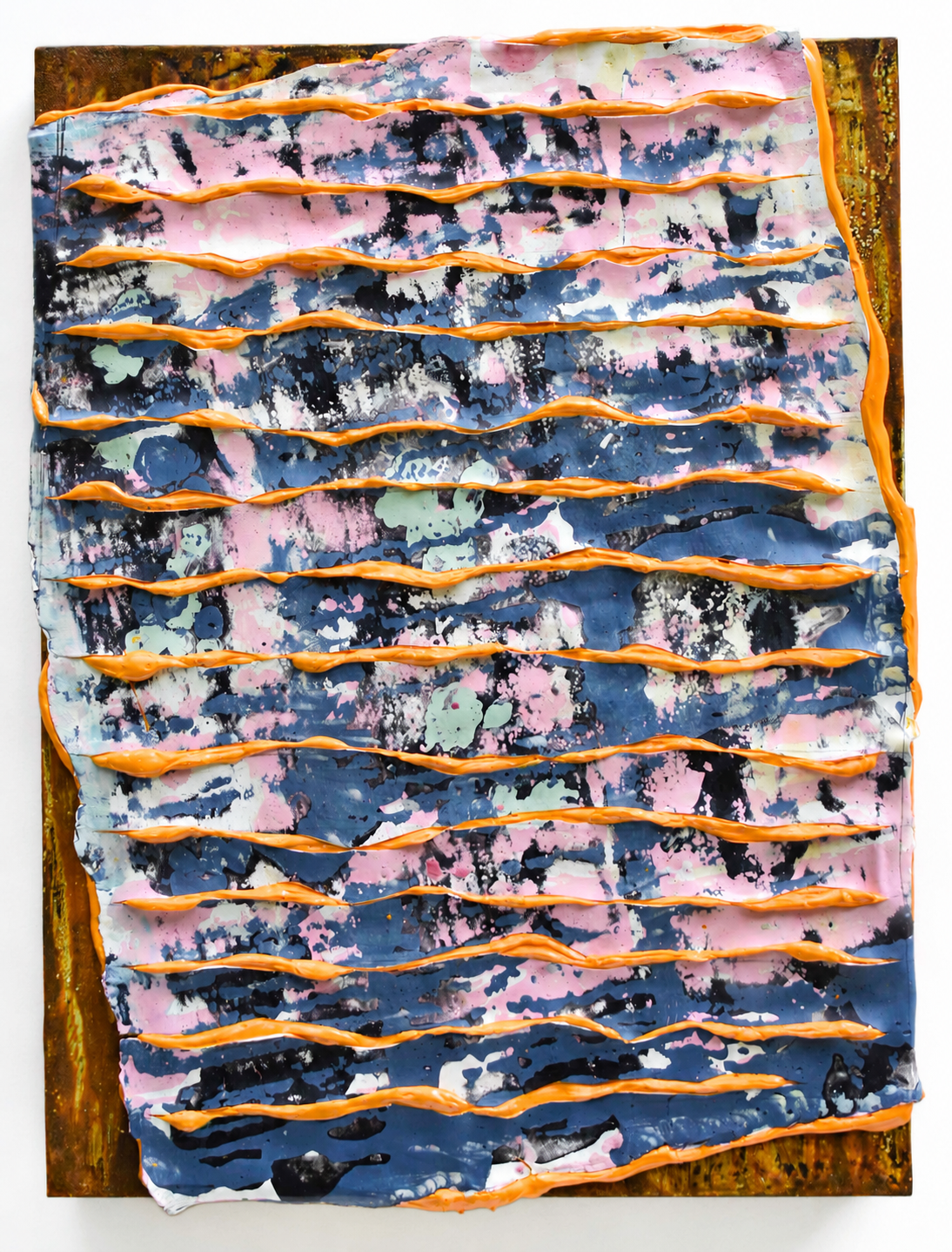
Pressed and Squeezed 4, 2025, acrylic, clay slurry, 16 × 12 × 2”
JF: Yesterday I had one of those moments. I was struggling with a piece and finally thought, This is awful. So I put it aside.
The advantage of understanding your own process is that you stop panicking. I knew I'd reached the point where I had nothing to lose, and once you're there, you're free to experiment.
I came back, changed a few things, worked the surface with steel wool, and suddenly it was there. You just know. That's the moment when you stop.
MS: That's the best feeling. Those moments don't happen often, but they're powerful enough to keep bringing you back into the studio.
JF: A friend of mine, Steve DiGiovanni, once said, “I am always looking for that one magical moment when a piece suddenly comes alive”. But to reach that moment, you have to make an enormous amount of work.
MS: That's been my experience too.
I've also become much more comfortable taking work apart. Earlier in my career, if I spent forty hours on a piece and realized it wasn't working, I felt defeated.
Now I think differently. Maybe the painting isn't successful, but part of it might become the beginning of something else. Nothing is really wasted.
JF: Absolutely. That's why I never throw anything away.
MS: Neither do I.
The studio has become less about preserving finished objects and more about maintaining an ongoing conversation, or creating an inventory of possibilities. Every unsuccessful piece becomes material for the next one. That takes the pressure off.
JF: It really does. There's no formula for making art. Every piece brings fear, frustration, breakthroughs, dead ends, and surprises. If you stay with it long enough, you begin to enjoy that cycle.
People sometimes ask why I keep doing this. I'm certainly not doing it for the money. I'm not rich. I'm not famous. But I feel incredibly fortunate that I've been able to spend my life studying one thing so deeply.
Over time, the work teaches you who you are. That's a gift. And here's something I've thought about more as I've gotten older: I'm never bored. There's always another piece to begin, another material to investigate, another question to pursue. That sense of curiosity has stayed with me my entire life.
MS: That's one of the things that attracted me to the studio when I was eighteen. There isn't a finish line. You never know when you'll discover something completely new. That might happen at forty or at eighty. You simply keep growing. I think that's one of the great privileges of being an artist.
Something I noticed when I visited your studio was that nothing felt overly precious. There were fragments, experiments, and works in progress everywhere. It seemed less like a place devoted to finished objects than to discovery.
JF: That's a good observation. The title of my upcoming exhibition is In Process… and that's really what my work is about.
I'm not someone who begins with a fully formed concept or a detailed intellectual framework. Some artists work that way, and that's perfectly valid. I begin with a material, a possibility, or simply an openness to what might happen.
For me it's all about play, process, accidents, and the unexpected. That's something I talk about with my students all the time. The unintentional is limitless. What we can consciously imagine is actually quite limited, but if you're open to unexpected discoveries, the possibilities become endless.
I tell my ceramics students that sometimes the pile of scraps beside the piece they're making is more interesting than the piece itself. Pay attention to that. It may not belong in today's work, but it might become the beginning of tomorrow's.
MS: I completely agree. Those accidental arrangements often reveal relationships we never could have planned. They feel honest because they emerge before we've had time to control them.
JF: If you walked into my studio today, you'd see work everywhere. Some artists work methodically—one piece at a time—but my studio is full of unfinished ideas.
I've learned that I don't need to force a body of work into existence. I just need to keep making things, follow the thread, and trust that the connections will reveal themselves over time.
People say, "Trust the process," and it's become a cliché, but I genuinely believe it.
MS: That's easier said than done.
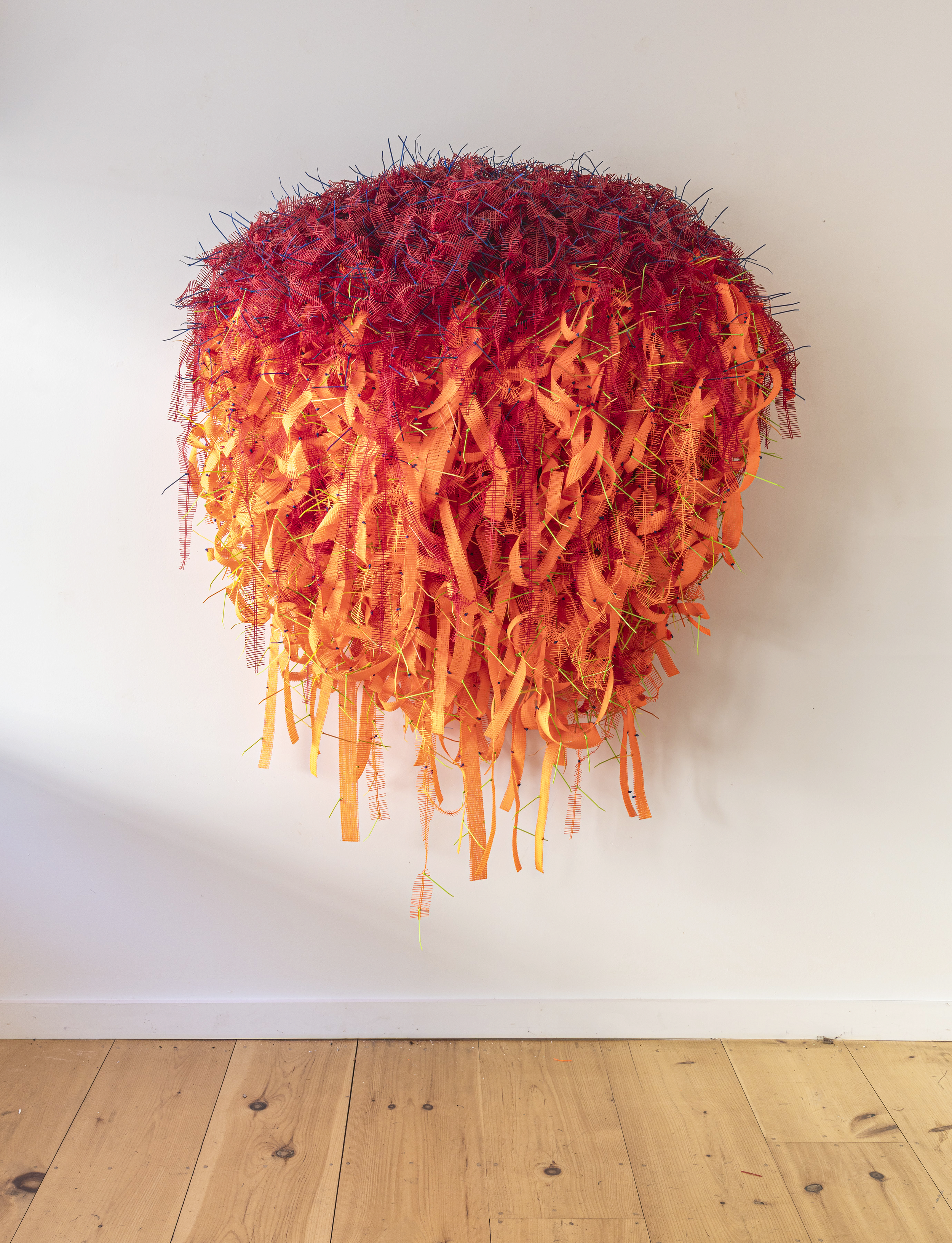
Burning Bush, 2001, Plastic fencing, 68 x 58 x 21”
JF: It is. Every now and then I'll deliberately make myself uncomfortable. I'll work in a way that doesn't come naturally just to see what I can learn from it. Then I'll bring those discoveries back into my own practice.
Discomfort is valuable. That’s one of the reasons Abstract Expressionism has always appealed to me. It wasn't prescriptive. It valued action, movement, and openness.
When I look at my own work, I realize movement has always been there. Whether it's sculpture or these newer flat works, there's a rhythm running through everything. I think that's simply part of who I am.
MS: I've often thought a healthy studio practice has a lot in common with athletics. Some of my favorite students are athletes because they're used to hearing, "Reset. Try again." Failure isn't an permanent — it's just part of getting better. That mindset translates remarkably well to the studio.
JF: I completely agree.
Art teaches many of the same life skills that sports do. An instructor once told my niece, who was a competitive skier, that he could immediately tell she was an athlete. She listened carefully, stayed disciplined, and wasn't afraid of repetition.
Those qualities matter in the studio. Talent helps, but persistence is what carries you through a lifetime of making.
MS: Sports have always been part of my life too. I grew up skateboarding and snowboarding, and I still participate in both. One of the things I love about those activities is that they demand complete attention.
JF: I skied for years, and I still play tennis. When you're skiing or playing tennis well, you're completely present. You're not thinking about yesterday or tomorrow. It's the same in the studio.
MS: That's the flow state. Whether it happens while making art, playing sports, or doing something else entirely, it's one of the great pleasures in life.
JF: I couldn't agree more.
That state of complete engagement is what keeps me coming back—not just to making art, but to teaching and to the creative community. It's all about staying curious.
MS: Earlier you mentioned that you probably wouldn't have been happy teaching at a large university. What made the community college environment such a good fit?
JF: I think it's a little more down to earth. I want my teaching to be as honest as my artwork.
I don't want people to feel they need a page of theory before they can have an experience with a work of art. I'd rather they be drawn in by a material, a process, or simply the question, How did this get made?
From there they can bring their own experiences to it. I don't want to provide all the answers. I want the work to ask questions.
The same thing happens in critiques. Students often see things in my work that I'd never considered. Instead of resisting that, I think, That's interesting.
Once the work leaves the studio, it belongs to the viewer too. I've never been interested in impressing people with complicated language. I'd rather have an honest conversation.
MS: I feel the same way about artist statements. Students will sometimes show me these elaborate statements, but when it comes to writing about art, I always encourage honesty above all else. I think it's best to write about the work in a simple, direct way rather than in language that feels pretentious or convoluted.
When you can talk about your art in a straightforward way, I think that reflects confidence. Overcomplicated artist statements often strike me as less secure. They also tend to pin the work down to a fixed interpretation. I'd rather approach someone's work with a sense of openness, and I want the same for my own. I don't want my work to communicate a single, fixed message. If it stimulates someone's imagination and leaves room for personal interpretation, then I consider that a success.
JF: I think that’s true. When I was younger, I could be pretty judgmental about work that wasn't aligned with my own interests. Teaching at a community college changed that.
Many of my students have very little experience with visual art. For some, this may be the only art class they'll ever take. I don't want them leaving thinking, Art isn't for me. I'd rather they leave feeling curious.
Maybe years later they'll walk into a museum without feeling intimidated. To me, that's success. Art shouldn't feel like it's reserved for specialists. It should feel accessible.
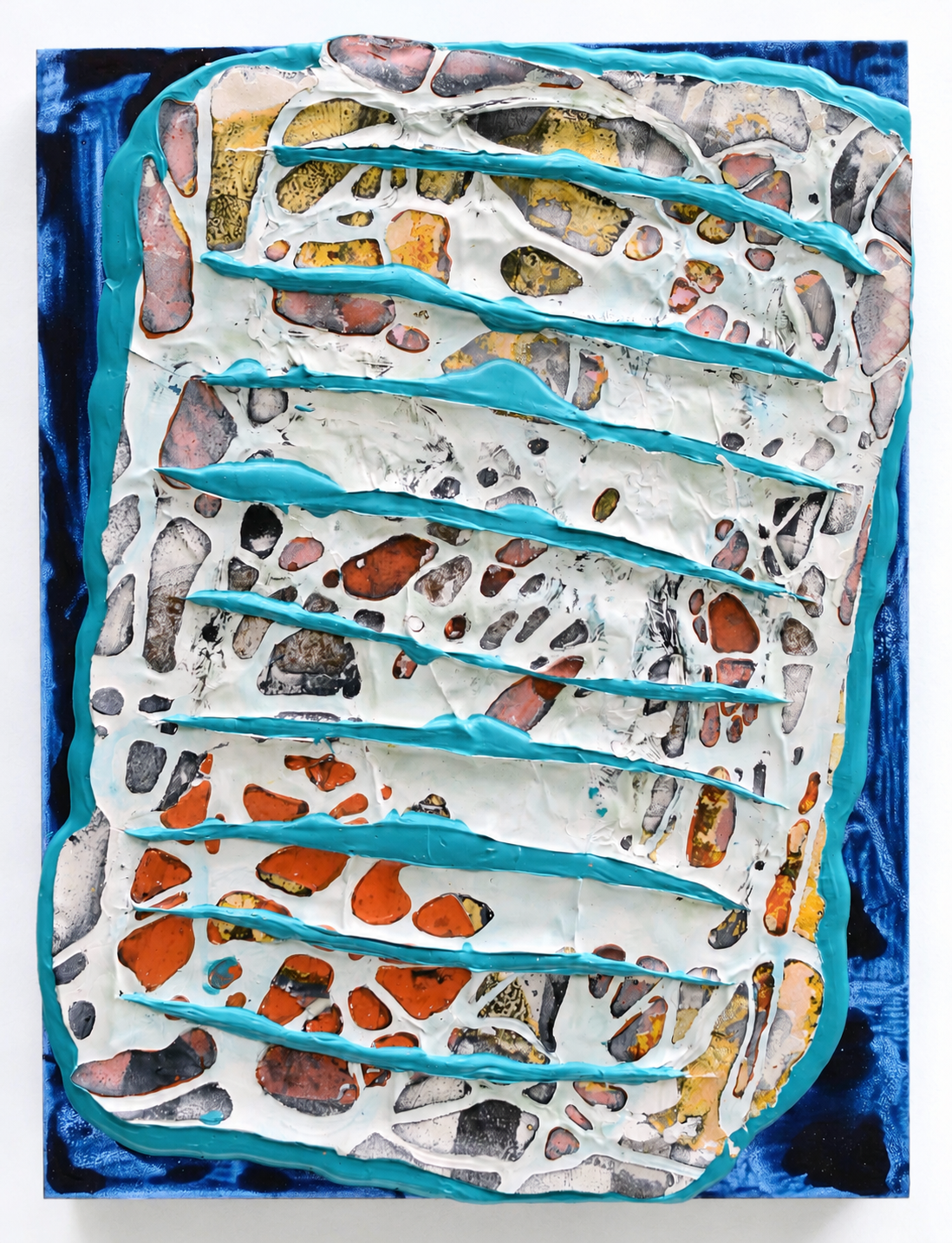
Pressed and Squeezed 5, 2024, acrylic, clay slurry, 16 × 12 × 2”
MS: I'd like to ask about color.
I teach color interaction, and I've always been interested in your relationship to color because it feels intuitive. Some of your work relies on familiar color harmonies, while other pieces create much less predictable relationships.
How do you think about color in your own practice?
JF: I've never thought of myself as a colorist. I've never formally studied color theory. Like so much else in my work, it's been intuitive. When I worked in clay, I hated glazing. I used to joke that black driveway sealer was my favorite glaze.
Then I worked in steel, where color wasn't really part of the conversation. Rubber was black. Color didn't become important until I started working with plastic fencing.
Those bright industrial colors completely changed the way I thought about visual relationships. In some ways, I think I learned more about color through plastic than through paint. Even now, I don't mix colors very much.
I work directly from the bottle and let the colors interact on the surface. I've used the same paints for years—not because they're objectively better, but because I know how they behave. Once you understand a material, it becomes part of your vocabulary.
MS: I understand that. I was always very quiet with my color choices. Most of the time I didn’t use color at all. When I started making collage, another artist observed that it had given me the opportunity to work with color again. I embraced that. For me, the color that I found in existing images was more approachable than color that I would mix in the studio.
I've always admired painters with extraordinary sensitivity to color, but I eventually realized that's not really my temperament. I'm more interested in discovering relationships between colors that already exist. But that’s only an occasional thing in my studio. I still work in monochrome most of the time.
JF: I think that's exactly the difference. Some artists enjoy building color from scratch because they know exactly where they want to end up. You and I seem more interested in discovering where the work wants to go. I'll see a color and think, Let's find out what happens. That's a much more intuitive way of working.
MS: Before we finish, I'd love to hear about your upcoming exhibition.
JF: It's opening in September 5th, 2026 at the G-Town Arts & Culture Center.
The exhibition will include sculpture—some familiar work and some pieces that haven't been shown very often—but what excites me most are the new paintings.
The exhibition is called In Process…, which feels appropriate because that's exactly what this transition has been. In some ways, I think of it as a thesis exhibition. For the last two years I've been focusing on an entirely new way of working, and now these pieces are finally ready to leave the studio. Having a deadline changed my rhythm.
Normally I just keep making work and gradually build an inventory. This time I had a specific exhibition to work toward. The pressure was different, but it pushed the work further than it might have gone otherwise. Sometimes it's good to change your pace.
MS: Deadlines can be uncomfortable, but they often bring a level of focus that's hard to create any other way.
Once they're over, it's a relief to return to a more open-ended rhythm.
JF: When you visited the studio, I remember thinking how rare it is to sit down with another artist and spend this much time talking about process.
I listen to a lot of interviews with Rick Rubin because that's what interests him—not just music, but creativity itself. I often get more from those conversations than I do from reading art criticism because the ideas translate directly into the studio. His book is something I return to whenever I feel stuck. I'll read a few pages and almost always come across something that helps me move forward. It's reassuring to be reminded that uncertainty is part of the process.
MS: I understand. Those conversations remind us that the goal isn't simply to produce objects. It's to stay curious.
When I'm working well, I enter that flow state where everything else disappears and I'm completely absorbed in the work. That's why I keep coming back to the studio.
JF: Me too. Of course I want people to see the work. I want it to start conversations. But the process itself is what keeps me going. I've been doing this my entire life, and I still find it endlessly interesting. The work gives me purpose. It gives me a community. Most importantly, it keeps me curious. I can't think of a better way to spend a lifetime.
Volume: Thanks to Joe for taking the time to talk about his work. His current show is on view at G-Town Arts. More of Joe’s work can be viewed on his website or on his Instagram account @fucigna.