

Jordan Martins
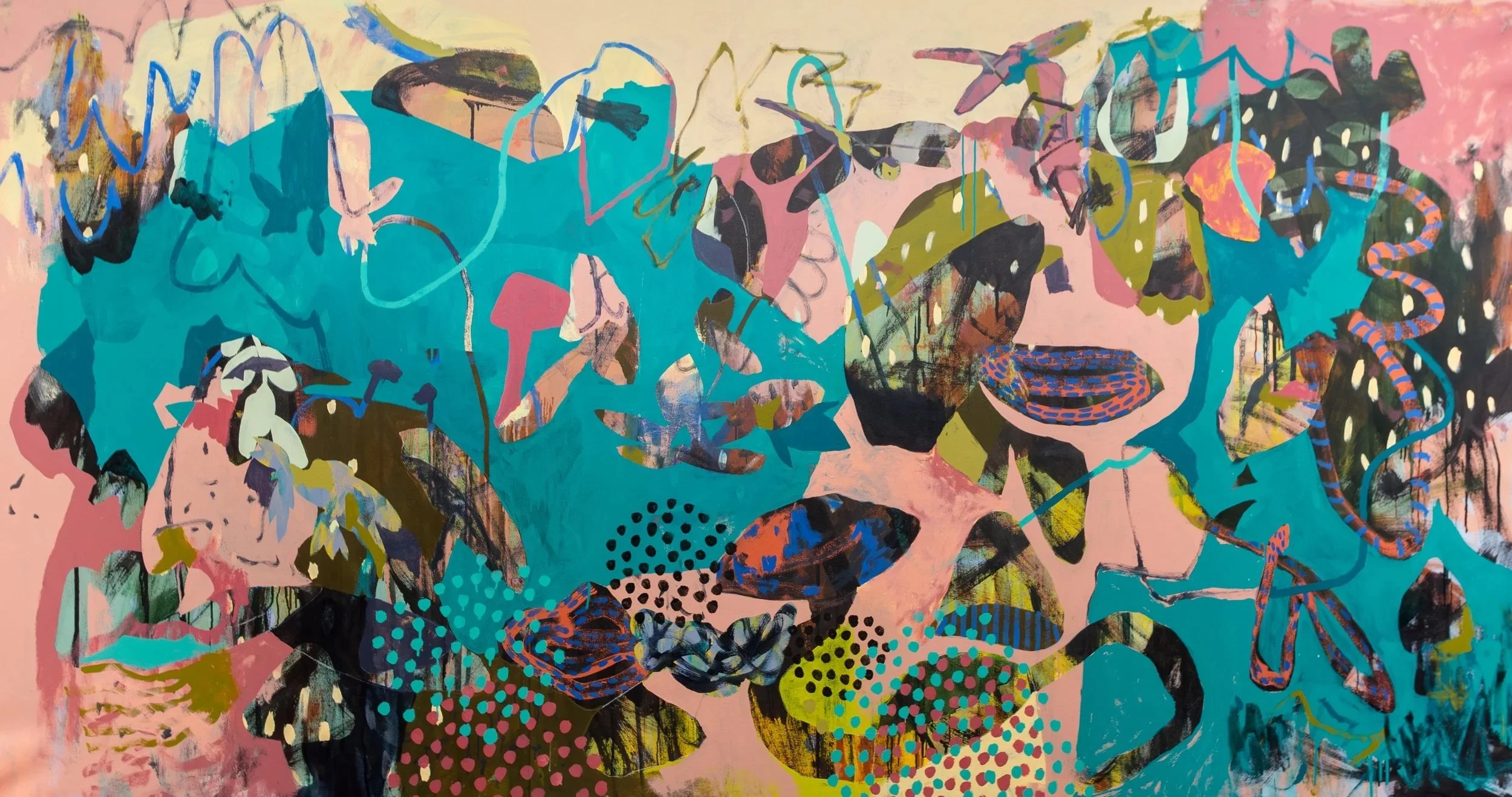
Sottoboso with Pond and Spores, 2026, acrylic on canvas, 64 x 124”
MS: I know you live in the Chicago area. Did you grow up there?
JM: I didn't grow up here. I moved here 18 years ago.
MS: Where are you from?
JM: I grew up all over the country. I was born in Oregon, and I moved from Oregon to Wisconsin when I was little, then to Louisiana, and then to Central California. I did my undergrad in Sewanee, Tennessee, and stayed in Tennessee for a few years.
MS: You're from Oregon?
JM: Originally, yes. I moved away when I was six, but Oregon still feels like part of my DNA. I lived in Aumsville, a small town outside Salem. In my childhood memory it was fairly ordinary, but when I returned as an adult I was struck by the mountains and the scale of the landscape. It felt almost like the setting of a Spielberg movie: a quiet town where kids ride their bikes everywhere.
MS: I grew up in Eugene, Oregon. As a teenager moved to Medford, which is in southern Oregon just above California.
JM: My dad went to seminary in the Episcopal Church in rural Wisconsin. From there, it was just a matter of him getting appointments at different churches, and we would just kind of move around.
MS: Where did you spend the most time growing up? Was there one place that felt especially formative?
JM: It depends on what you consider formative. And I'm very fragmented. And in certain ways, my art practice has been shaped that. I'm not sure there's a causal connection, but there's kind of a formal one. I've always really felt like my biography and my identity comes from where I grew up, but that feels king of stitched together. It was like a collage. I'm a little this, I'm a little that.
I moved to the South to Baton Rouge when I was 10. We were there for about 5 years. It was a jarring move. I had grown up in rural Oregon and then even more rural Wisconsin, and then all of the sudden we moved to the South
The culture of the South is so layered and complicated. In addition to trying to adapt the the environment of the South, we were also thrown into high society because my dad’s position as an Episcopal priest. Because of his connection to the church, all of us kids received free tuition to one of the nicest private school in Baton Rouge.
So all of a sudden I was 10 and adjusting to the social mores of high society Southern was very strange. So I don't identify with any of these places in particular, even the ones where I spent the most time.
MS: I can relate to that feeling of a fragmented regional identity. I grew up on the West Coast and moved to the East Coast when I was 24. I have been here for almost 20 years. Soon I will have spent an equal amount of time in both places. At this point, I no longer fit in on the West Coast, and I’ve never felt totally at home on the East Coast either. I’m a mixture of both places, but not fully compatible with either one.
When did visual art first become important to you?
JM: I mean, as young as I can remember. We lived in a pretty rural area and it was the '80s, so there wasn’t a lot to do. I loved drawing and would spend hours in my room alone drawing just obsessively.
When I started the first grade, I had the my first art teacher. That was meaningful to me. I had a period of my day that was set aside for art. My teacher was very encouraging, which meant a lot to me. My parents had supported my artwork, but having a mentor at school affirm my interests - I think it was really impactful.
I remember getting these workbooks and learning that the print quality of the images was basically just outline graphics. It was fragile enough that you could erase it with an eraser. I would like erase parts of the printed images in these workbooks. And I was just really kind of smitten with that. I realized that I could alter things and make them look different. Not long after that, I started to really identify as an artist.
Later, when I learned that like there is such a thing as college and you could major in art, I was like, yeah, I'm probably going to do that.
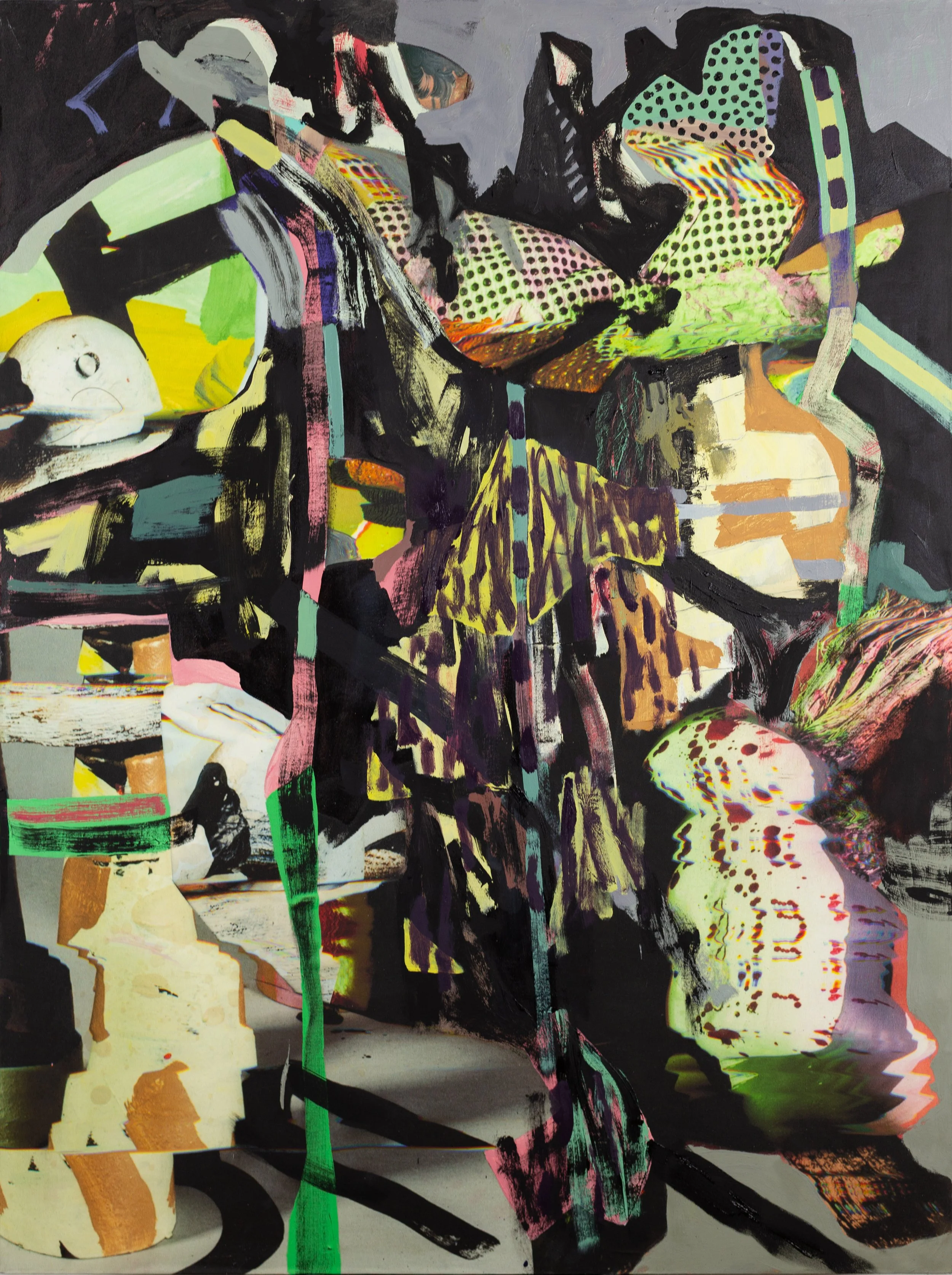
Market Scene (After Beuckelaer), 2026, oil on inkjet printed cotton / linen canvas, 48 x 36”
MS: That sounds familiar. I grew up on the outskirts of Eugene, Oregon. My Mom was always involved in DIY projects, and it rains constantly in the Pacific Northwest, so I spent a lot of drawing. I was an only child, so making things became a natural way to occupy myself.
Art was also the first place where I felt connected to school, and it eventually became a gateway into education.
You completed your undergraduate degree in Tennessee, correct?
JM: Yes. My sister was on a college tour when we lived in Baton Rouge, and along the way we visited Sewanee. There was an Episcopal seminary there, so my dad had been aware of it. We went there, and I remember being struck by it. Both of my sisters ended up going there, and I visited several times. And it was just like, this place is so amazing and crazy. And so I eventually went there.
MS: Was there something about it that you gravitated toward?
JM: It’s an incredibly unique place. It's on top of the Cumberland Plateau, so it’s essentially up on a mountain. As you go up the plateau coming from Nashville, but before you descend pretty aggressively down into the valley around Chattanooga, there's this amazing campus built around the time of the Civil War. It looks like Hogwarts. It's just this crazy Oxford-style Gothic sandstone campus that's nestled in 10,000 acres of preserved forest on top of a mountain. The place has a sublime quality.
I remember first visiting in the wintertime, and there's a famous atmosphere of fog around Sewanee. I was walking between buildings at night, and it was white or gray with fog, and then all of a sudden this mossy Gothic stone building would appear. On a visit, one of my sisters connected me with Ed Carlos, who was one of the senior art professors there.
He was very gracious to meet up with me and talk to me. I hung out around his front yard for 3 hours and talked with him. I was hooked on the place. I was like, this place is so magical, there's all these really deep people studying here in this incredible landscape.
The place has such a unique history; a complicated one. A lot of kids from prestigious private schools continue to Sewanee. A lot of high society Southern debutante people end up there. It's not all that, but it's a huge quotient of it.
I don't identify with those people, but I recognize them. I'm familiar with that language and I find it both off-putting and charming at the same time. It felt like the right place to delve into my personal interests and weird currents of curiosities.
MS: Yeah. When you were getting ready to go there, did you already have material track that you were on? Were you already committed to a single discipline like painting? Or were you pretty open to exploring like the whole range of what the art department had to offer?
JM: I was really kind of archetypal “painting is serious” guy. I was marked with that for better or worse. I had moved away from drawing into abstract painting. I was trying to make sense of all of that.
I also had a background in darkroom photography from high school. And again, there's a really just absolutely masterful darkroom professor there, Pradeep Malde. So I dabbled in that as well.
I was also majoring in philosophy, so that limited the range of other disciplines that I could take courses in. So for instance, I didn't take a sculpture class. There was a video class that, for a very small school in the late '90s, was a really strong class, but I didn't have an opportunity to take it.
MS: Yeah, I read that you studied philosophy. Was there a particular branch of philosophy that you studied?
JM: I wrote my undergraduate thesis on Wittgenstein and then a Chinese Taoist, Zhuangzi, an ancient Chinese Taoist. I was very interested in both of those strains. Like, I got to Wittgenstein late through my advisor because I was really interested in existentialism. That’s kind of standard for a teenager who is practicing abstract painting right? It's like that template.
I was really interested in Nietzsche. I went from Nietzsche, to Heidegger, to Derrida and then to post- structuralism. I was also breaking away from the Episcopal Church and Christianity more broadly. I came across some Taoist writings that resonated with me and helped me develop an understanding of being in the world. My advisor at Sewanee was of the analytic philosophy tradition, but he had way more interest in the continental lineage than most analytic philosophers did. So he was a real big Nietzsche scholar, but he was also interested in Chinese and Eastern philosophy. Our department didn’t have much for Eastern philosophy, and he wanted to do some formal study and bring that into the department as well.
So when I got there, it was the first ever Chinese philosophy class offered. And he was so wonderful because he was like, I've read this stuff, I'm doing my best, but I'm learning it too, and we'll learn it together.
It worked well for me because I was really interested in that kind of philosophy. I was following this post-existentialist into post-structuralist lineage. I appreciated that, but I also wanted some other angle to explore as well.
This professor, he was a Wittgenstein scholar first and foremost, and he taught a Wittgenstein class, but I couldn't fit in because I was double majoring in art. I just couldn't fit in all these philosophy classes. So finally, my senior year, he was like, let's just do an independent study I'll personally just sort of give you a crash course in Wittgenstein. And I ended up loving it and was writing about it. I was trying to merge some of the Wittgenstein thinking with this Taoist philosopher Zhuangzi. A lot of it is the philosophy of language. And a lot of that seeped into my artwork at the time in my senior thesis show.
So it was a really nicely integrated experience between those two majors.
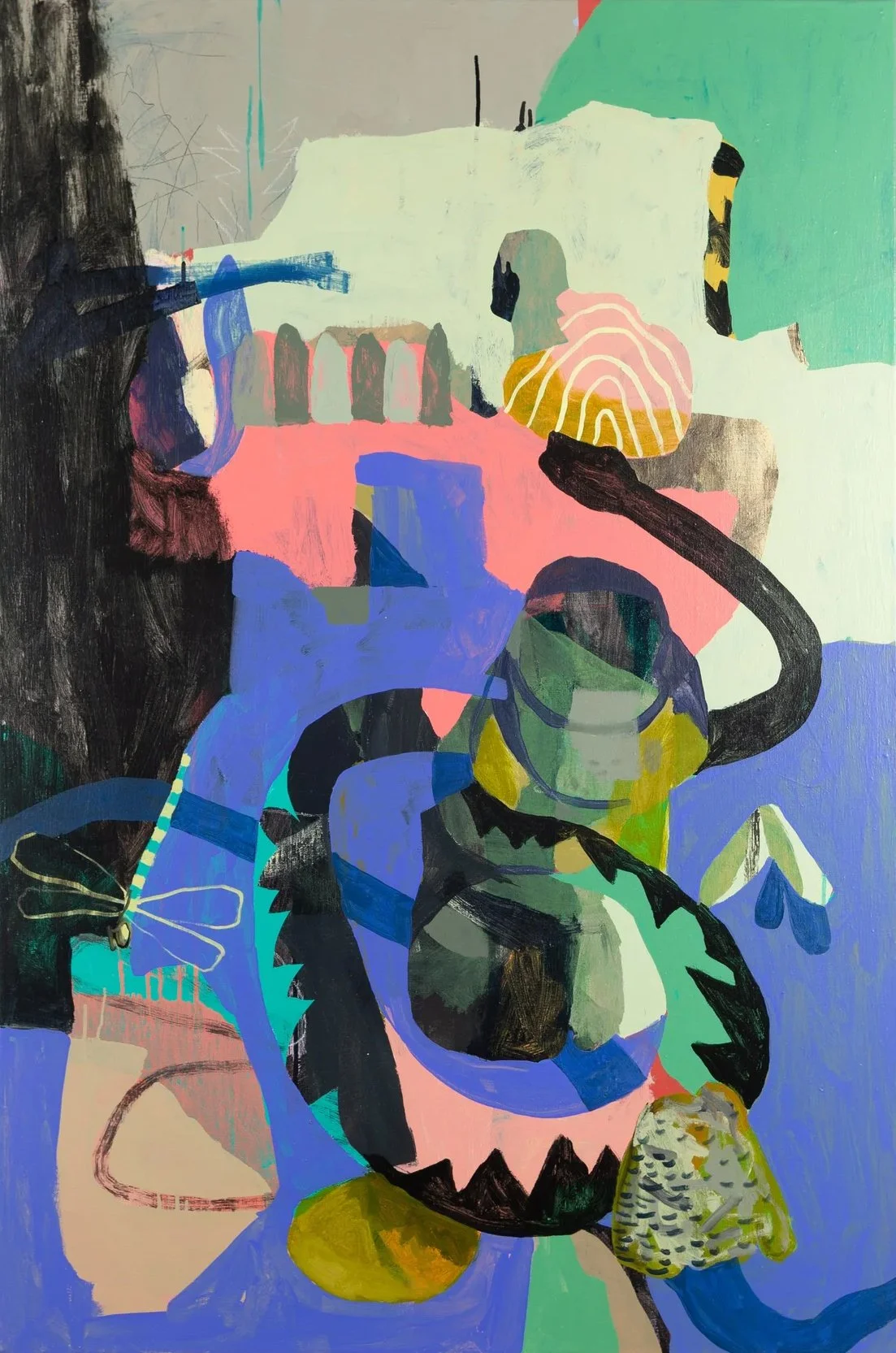
Moonlight, reflected in dewdrops, shaken from a cranes bill, 2025, oil on inkjet printed cotton / linen canvas, 48 x 36”
MS: Did you go directly from undergraduate study to graduate school, or did you take some time in between?
JM: I took 3 years in between. I moved down the mountain to Nashville for 3 years with some friends from college. I was also dabbling in music. And so for those 3 years, I kept my painting practice alive, but I was also playing music and kind of feeding that curiosity. There was a really thriving experimental music scene in Nashville at the time. I spent 3 years there involved in that community.
I think I always knew that visual art would need to be in the front seat, but I wanted some time just to kind of enjoy being in the music scene. I was getting deeper into improvisational music. I’m not a trained jazz player, but I'm interested in a lot of that music. I was fascinated by like the burgeoning noise scene in Nashville. I was hearing it as something connected to Coltrane, but other people were coming to it from punk bands. It was an experimental scene of people who kind of arrived at it from very different places.
It was just so thrilling that I stayed there, mostly immersing in that scene. I was keeping my painting practice alive and I knew that I wanted to go to grad school sooner than later. It was always on the horizon. I didn't want to rush into it, but I knew that I would be going in 3 years max. So it was always a temporary stay in Nashville.
MS: I went directly from my BFA into an MFA program at American University. Although it was an excellent program, I sometimes wish I had spent more time working an independent practice first. That would have given me the opportunity to gain independence from my undergraduate professors and build confidence. If I had done that, I think I would have been more relaxed during my MFA program.
You eventually went to Brazil for graduate school. What led to that decision?
JM: My dad was born in Brazil and my grandfather was Brazilian. I always knew that I was Brazilian, but it felt almost theoretical. I understood that I had a family history there, but I didn’t relate to it directly. My grandpa had an accent. He never spoke Portuguese, around his kids or grandkids though. He had Alzheimer's and when he was in the late stage of that, he stopped speaking English and started only speaking Portuguese. That connected me to his history and my heritage.
I realized that he was one of 7 kids, and that I must have a ton of family there that I've never met. There was a few members of that family who had visited the United States, but I didn’t meet them.
I think I was so daunted by applying to any grad school. I had got some advice about where I should apply but was still uncertain about the whole thing. Back then a lot of programs didn’t even have websites.
I understood that each program had a unique structure and subculture. I understood that each school was different and that you might want to consider how you would fit into their value system. I knew that you should consider what your goals are, and how that would fit into an MFA program, but I was so far removed from the practicalities and the realities of it.
Around that time I started getting interested in Brazil. And then my mom, who is just this kind of magical person, she wasn't from the Brazilian side of the family, but she knew that I was getting curious about that. She heard an NPR interview with this renowned and really important Brazilian singer, Caetano Veloso. He was on a press tour of the United States to promote his autobiography called Tropical Truth. It’s a wonderful book.
He was part of the psychedelic movement in the ‘60s. He’s a real intellectual. He's a musician, but he's really an artist. My mom heard him speaking, and she's like, oh, I think Jordan would love this, so she bought me that book for Christmas.
I started reading it Christmas Day, and in two days I had finished it. I was enthralled. He was talking about all these places I knew that I had family. I had been told that our family is scattered between Rio, Salvador, and São Paulo. He's talking about those 3 places constantly. Sure. That really stuck in my imagination. When I was looking at schools, I'm like, well, surely there are art schools in Brazil. Surely there are MFA programs there. There was just enough information online for me to butcher my way through 3 applications. I was just beginning to learn Portuguese. I was building that out on top of a pretty fluent sense of conversational Spanish, which helps, but they're different. I was writing these admissions essays and artist statements in this complete patois of different fragments of language and then printing them and mailing them with slides, and sending them in packets across the ocean.
I don't know why I've always been more inclined to do the stupid thing, or the improbable thing, and take a leap of faith. I know that I'm probably going to land somewhere weird and different, and that I can't predict if it's going to be worth it. And that's exactly what happened. So I threw myself into it. I should say too, that my wife and I were dating long distance at the time. We were incredibly in love and just feeling invincible. And I was like, hey, I might want to go to Brazil for grad school, would you want to come? She's like, hell yeah, I would. I think if I hadn't gotten that affirmation from her, let alone her partnership, I probably would have chickened out at some point. But we, in the fog of love, we just decided this is what we're going to do. And we did it.
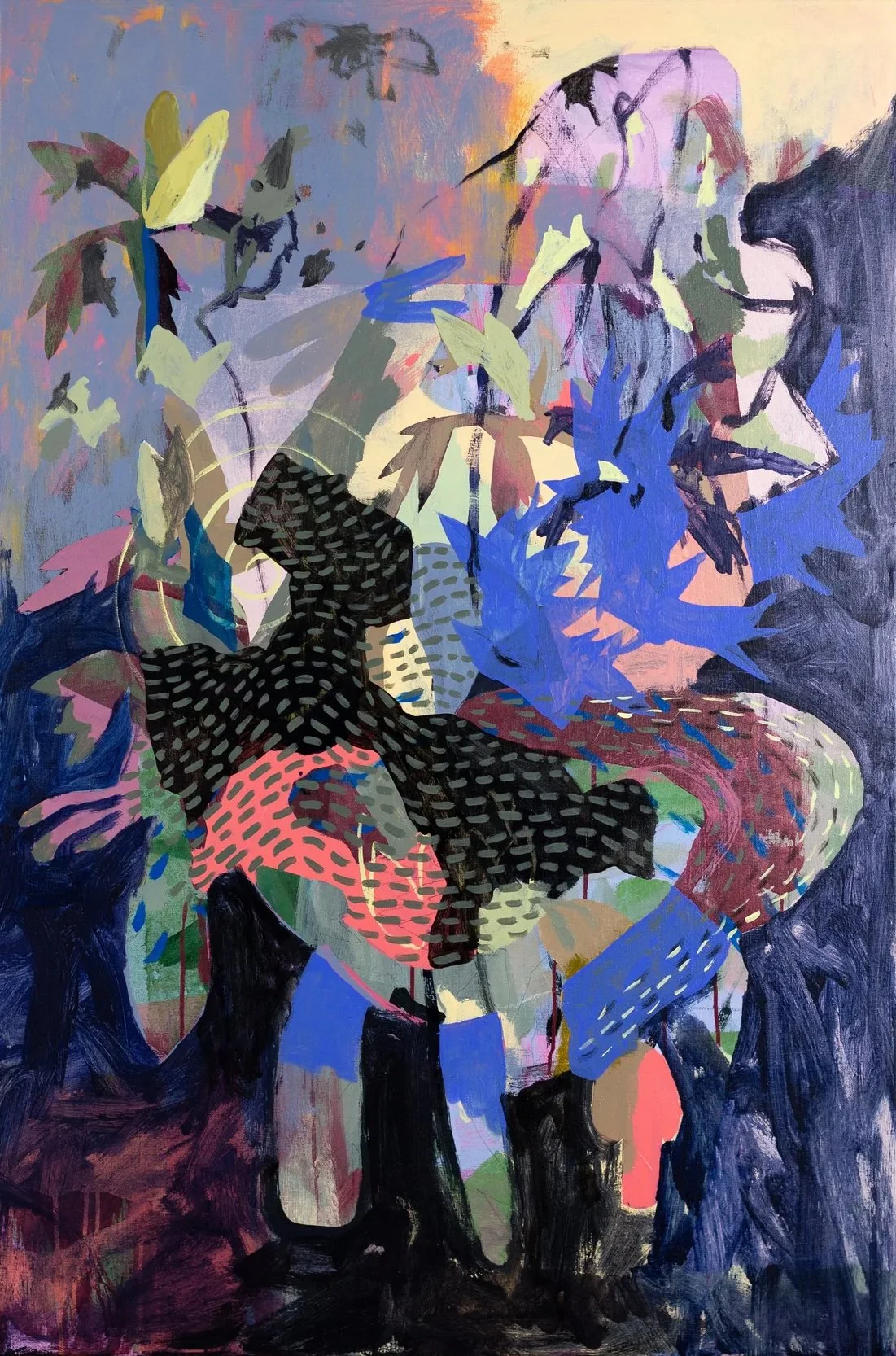
Sottobosco with Snakes and Butterflies, 2026, acrylic on linen, 48 x 32”
MS: Moving toward your more recent work, landscape seems to run through much of what you do. You were making abstract paintings as an undergraduate, and I assume that continued in graduate school. Was that work already shaped by land and environment, or did those concerns emerge later?
JM: Strangely, I'm just now re-engaging with landscape, and I’m picking up on something I left off on when I finished graduate school. I think depending on how you understand what landscape can encompass, I've had those inclinations running through me in different ways throughout my career.
The paintings that I made in school were definitely engaging in abstract landscapes, but in a much more minimalist way. I was using collage and different materials as a way to kind of build up a surface that could be wandered into. I was really influenced by like Chinese landscape and those panoramic compositions.
I wasn’t invested in ecology or other sort of themes of landscape, but I still considered landscape in my work. And then I really took a different turn. Over the last 15 years I was hyper-invested in the logic and process of collage. I was really interested in how to push the language of collage and push the materialities of collage. I wanted to get beyond the usual found image method and look at different ways of cutting and gluing it down material. That led me down various rabbit holes. Around 2015, I started making work using scanners as a way of developing my own source materials.
I would convert my studio into a photo studio for months at a time, and shoot subjects in a very open ended way. I would gather and construct different objects, and I was thinking a lot about camouflage and hallucination. If you’re thinking about camouflage and hallucination, you're imagining that as situated within a landscape. I was obsessed with thinking about how our brains and how our perceptual faculties process information of our environment to find patterns. This is what camouflage and hallucination is all about. I was very interested the way this was approached in the early 20th century.
If you look back at early modern collage there was this painter Abbott Thayer. He was a landscape painter. Camouflage as an idea emerged in landscape. It was used for landscape purposes in war.
Recently, I started to think about still life again. For years I was like, I don't give a shit about traditional genres like still life, portrait, or landscape. Those are such restrictive terms. But more recently I find them really productive.
I started looking back at still life and realizing just how strange and abstract it all is. Even if you're looking at a really old classical still life that is hyper-realistic, it's like the way that that artist assembled those objects together is itself this strange assemblage of abstraction.
If you take it further to Cubism and Morandi the sense of abstraction obviously becomes very pronounced. Where there's a sense huddling some objects together in an almost arbitrarily way. Then there’s this disruption of space and on top o that they are rendered in collage.
I was really invested in that way of working
You know, in a weird way you kind of get a merger of portrait and still life that way. It's like they both have a kind of a central pile of either human form or still life objects. And then there's like negative space around it.
In the last few years I started looking at this particular Dutch tradition of still life called sottobosco. It means on the forest floor. They are still life paintings situated within a landscape. You could also say that they are landscapes in the format and the scale of a still life.
MS: This is one of the things that really caught my interest. You shared some videos on Instagram that explain this. Like yourself, I don’t have a desire to learn to paint according to any classical tradition. However, the classical genres of landscape and still life are still very relevant to my practice.
Just as you’re saying, the composition and formal tendencies of those genres can be very appealing to me. Looking at those paintings can encourage me to approach something from a different angle. So I understand how a person can make things inspired by those traditions, but without seeking to emulate them.
Landscape is a difficult thing to talk about in contemporary art. If someone asks me what kind of work I make, I'm never entirely sure what to tell them. Because most of my work is about land and environment, but if I say that it sounds a little too conceptual. I'm not out there making land art or doing something relating to environmental issues.
Although, If I say that I work with landscape, a lot of people will assume that I mean in the vista sense, like scenery paintings. I have a hard time describing my work because it’s neither one of those things.
I like to use visual art as a way to situate myself in space. If I’m in a place, and there’s a quiet moment to reflect on where I am, my impulse is to use something visual to describe that. I like to think about the scale of the things that surround me. I like to think about my perception and the spatial distortion that goes on there. In that sense, my work is connected to landscape, but isn’t really a part of that genre.
I can relate to your interest in the sottobosco tradition because it deals with landscape at an unusual scale. It’s a still life arrangement on the forrest floor. That’s pretty great.
A couple of years ago I organized a show called Ground Level. It featured artwork from 5 different artists who deal with landscape at close range. The show focused on what the textures and details say about different places. It was about how close range sensations say more about a places than a vista. I thought about that show when I saw your videos on sottobosco.
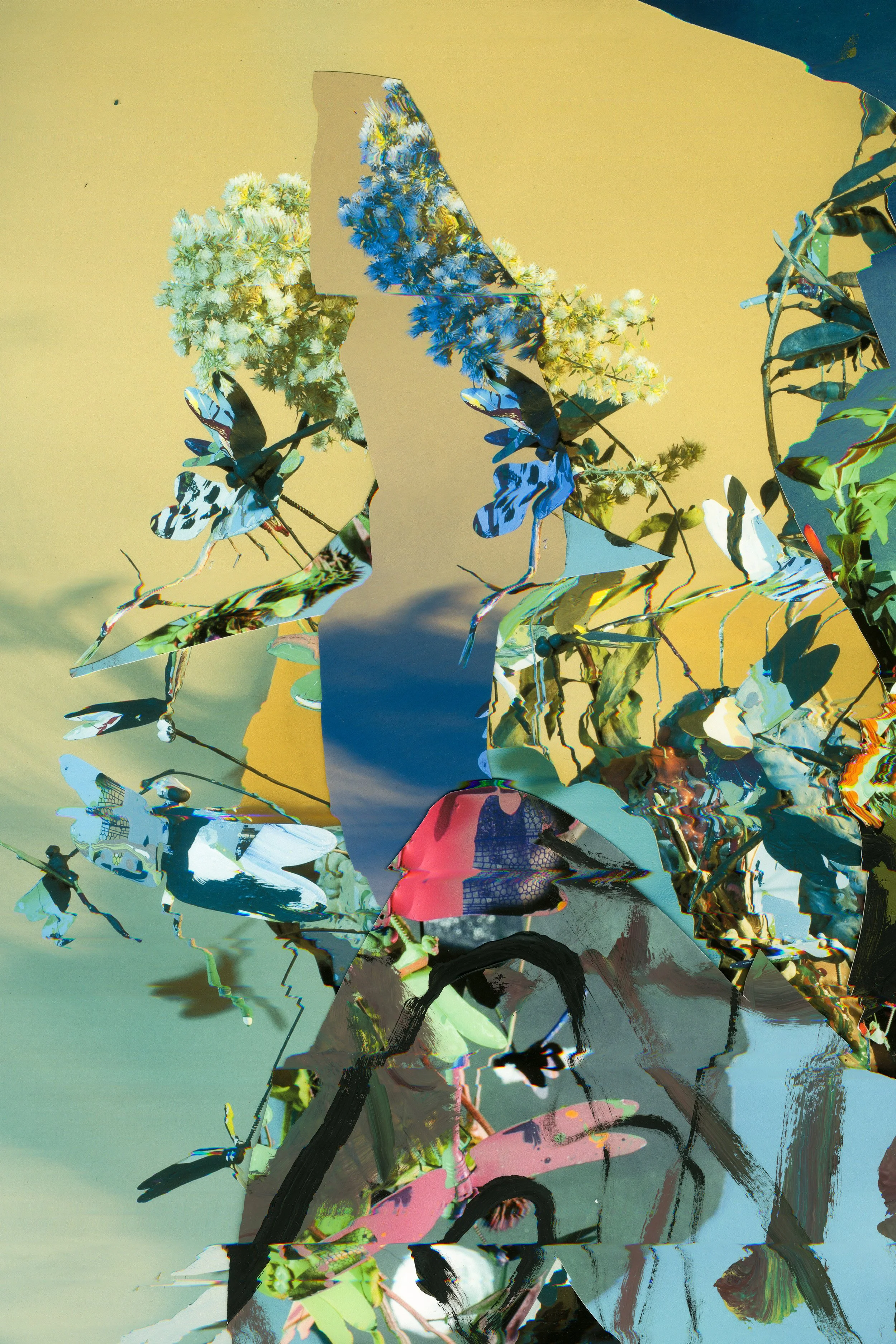
Phenotypes, 2016-2025, archival pigment prints, 36 x 24”
JM: I posted another video describing specifically how I fell into it. I’ve been making this series of scanner collages since 2015. I call the series Phenotypes because I was looking for a term that could describe a sense of mutability. I think about genetics as an allegory for image mutation. It seems a fitting way to describe how images can develop through variations and mutations. The series became a kind of feedback loop of image creation and an experimental space where I could bring together different interests.
For years, I was thinking about camouflage and hallucination. I was mostly photographing still-life compositions, arranging different objects and materials. A few years ago, I became interested in incorporating dragonflies into that work. I bought some toy dragonflies—the kind you stick in the ground on a wire—and started dipping them in paint, photographing them with different materials, and constructing these strange little dioramas.
That led me to research other image traditions involving dragonflies. I’ve been particularly obsessed with the Dutch still-life painter Willem van Aelst. His work is so abstract and strange. I kept wondering, what was this guy doing, piling things up in these particular ways? To me, he seemed like one of the most abstract painters of that time and place.
So I Googled whether Willem van Aelst had ever painted dragonflies, and sure enough, he had. Before that, I had mostly known his work through another strange subgenre: hunting-game still lifes, where you get these elaborate arrangements of dead game—a deer head, pheasants, and other objects all piled together.
I learned that he had dabbled in this genre called sottobosco, and his contemporary, Otto Marseus van Schrieck, was really the progenitor of the genre. Only a handful of artists in the mid- to late seventeenth century participated in it. It was never a particularly large genre.
If you look at vanitas still lifes—lobsters, flowers, oysters, grapes—hundreds of artists were making those paintings. There was enormous demand for them. Apparently, there wasn’t much demand for the subgenera of sottobosco.
When I stumbled onto these paintings, and specifically van Schrieck’s work, I started comparing them to the scanner collages I was making with dragonflies. I realized, Oh, the work I’m already making has a preexisting genre. It was a strange and somewhat arbitrary realization: this obscure Dutch still-life tradition could become a container for describing work I had already made.
MS: That close attention to the forest floor really appeals to me. The smaller textures and easily overlooked details often shape my experience of a place more than a distant vista does. I’m also interested in how these paintings use natural forms to construct allegories while shifting the scale through which we view the landscape.
I love running those older traditions through a contemporary lens because, as you’re saying, all painting is fundamentally abstract. There can be incredibly appealing shapes and negative spaces in older works that I want to extract and incorporate into my own work. Because I work a lot with collage, that approach fueled my practice for a long time—pulling small moments from older paintings and placing them into new contexts within my own work.
JM: I’ve done a fair amount of that in past work, and it’s one of the moves I’m trying to make in this body of work while balancing it with more open-ended explorations.
But going back to what you said about scale, I was at the show the other day doing a walkthrough, and as I was describing the work to someone, I instinctively hunched down toward the floor to illustrate the vantage point. To your point, it’s not a vista, although occasionally there might be a hint of one in the background. But even then, you’re viewing the scene from close to the ground, which isn’t how we typically experience a vista.
You’re looking at what’s immediately in front of you first. There might be a sublime sky far off in the distance, but your attention is focused on the insects and plants at your feet. What I love about that perspective is the sense of different species converging on the same place at the same time.
In one sense, you could say these paintings are ecologically accurate. The species depicted generally would have occupied the same environments. Van Schrieck even maintained something like an ecological preserve, with a pond where he could study plants and animals. But the paintings can look strangely artificial because everything is happening at once. There’s a snake wrestling something away from a frog, insects everywhere—it’s as if every creature that could possibly inhabit that environment has appeared at the same moment.
What fascinates me is that this artificial compression expresses something deeply true about ecology: there’s always more going on than we realize. There’s an amazing book called The Forest Unseen by David Haskell, a former professor at Sewanee. He spent a year observing a small area of forest floor near Sewanee called Shakerag Hollow, which I’m actually making a painting of right now. He returned to the same place throughout the year, documenting the different species he encountered and the biological processes unfolding there, even in the coldest part of winter.
The book describes this staggering multiplicity of life happening beneath and around us all the time. If you look closely enough, there are countless overlapping processes and realities occurring within even a small patch of forest. These paintings render that idea in a strange way. They may look artificial, but they capture something true about the density and complexity of an ecosystem.
That’s also why the traditional vanitas interpretation has always fallen short for me. Vanitas paintings often carry a Christian moralism about the fleeting nature of earthly life and the danger of becoming attached to worldly things. These paintings feel almost more Buddhist to me, perhaps unintentionally. I see a swirl of life, death, and transformation—something much more cyclical. There’s a snake eating an insect and flowers dying, but there are also mushrooms emerging from the ground and other forms bursting with life. Death and regeneration are happening simultaneously.
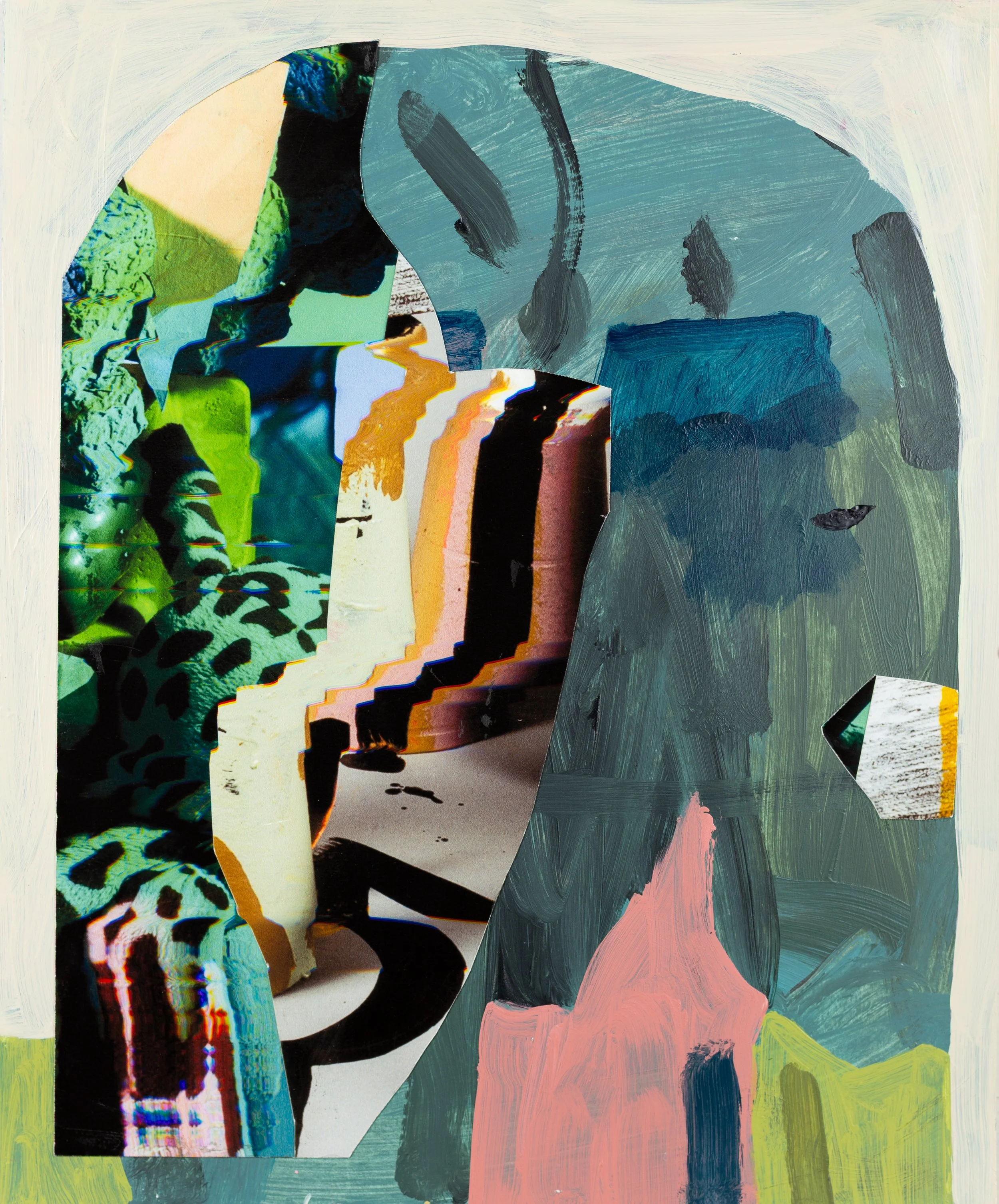
Mentogg Pull, 2023, collage and paint on paper, 17 x 14”
MS: You mentioned an early interest in Eastern landscape painting. I remember reading about how some of those works organize time and space in a way that’s very different from Western perspective. Rather than presenting a single illusionistic viewpoint, they allow the eye to move through a flattened landscape almost as a person would travel through it. That seems relevant here.
JM: Absolutely. That’s directly relevant. What fascinates me about these Dutch still life paintings is that they engage with those ideas while also embracing this quintessentially Dutch Baroque approach, where everything is rendered in exquisitely precise detail. That precision is very different from the Eastern traditions we’re talking about, but the tension between the two is what interests me. The paintings seem to buckle under all that detail and begin to slip into stranger, more psychedelic territory.
MS: I recently watched a documentary called The Renaissance Unchained, which discusses how Flemish painting renders everything in such sharp focus that it differs radically from ordinary vision. The documentary makes the point that this hyperrealism is also highly fabricated and abstract, because we never actually see the world with that kind of all-over sharpness and detail.
You might check it out. It’s a little corny, but makes some very good points. It raises some interesting questions about whether the Renaissance was as stable and rational as we tend to imagine it. Maybe some of those artists were less rational and much more mystical in their thinking than we realize. It also reminded me of what you were saying about camouflage and the way you’re painting these forms.
I’m probably bringing some of my own interests to the work, but I see a lot of spatial play happening in these paintings. The figure-ground relationship is constantly pushing and pulling, sometimes even becoming inverted. Things that should recede into the background suddenly push forward.
That reminds me of reading about early experiments with camouflage in the twentieth century. I had always assumed that camouflage was meant to make something disappear into its surroundings, but I learned that some camouflage, like on naval ships, was designed simply to disorient the shooter. The goal wasn’t to make the vessel invisible. Instead, the patterns were designed to confuse the attacker’s perception of the ship’s position, direction, and distance. Camouflage, in that sense, becomes less about hiding something than destabilizing your perception of where it exists in space.
JM: It would also confuse the vector of the ship. You couldn’t tell which end was the front, and the patterns could create the impression of a different wake alongside it. I sometimes forget how relevant my fifteen-year exploration of camouflage and hallucination is to this work, so I appreciate you bringing it back up.
For years, I was looking at those kinds of experiments, but also at how camouflage operates in nature. Animal coloration can be designed to conceal, but the same pattern can also be highly conspicuous. Zebras are a good example. Biologists still debate the functions of their stripes, and that ambiguity interests me. In certain environments, the stripes can operate as a disruptive pattern, but they’re also incredibly bold and visually striking.
I started thinking about camouflage through a series of oppositions. If camouflage attempts to hide something that’s present, what is its opposite? One answer would be conspicuous display—using color or pattern to attract attention. In nature, that might be used to attract a mate or send a warning to another species. A bold pattern can essentially say, “Don’t mess with me, I’m poisonous.” A rattlesnake does something similar with its rattle, but it can also coil itself into a pattern that makes its presence more prominent. So one polarity is between evading perception and deliberately attracting attention.
Then I realized there was another polarity. Camouflage hides something that is present, while hallucination creates the perception of something that isn’t present. But these processes can overlap. Camouflage doesn’t necessarily work by simply concealing something; it can work by suggesting the presence of something else. The pattern visually attaches itself to the surrounding environment. Instead of recognizing the shape of a nose or an eye socket, you might perceive the shadow of a bush. The figure seems to graft itself onto its surroundings.
As a fellow collage artist, you can see how all of this relates to collage. It’s also at play in Cubism, modernism, abstraction, and the collapse of figure and ground. That’s the formal language I’ve been working with for years, and it’s what I brought to this new body of work.
To your earlier point, all painting is abstract. From that perspective, a Dutch painter is as engaged with abstraction as anyone else. Even within those highly descriptive paintings, there are moments when figure and ground begin to collapse and the image becomes something stranger.
MS: As we talk about camouflage, those figure-ground shifts become especially interesting to me. My perspective on camouflage changed as I read more about it. I never went deeply into the subject, but I came to understand that camouflage is as much about disorientation as it is about concealment.
The figure-ground shifts in your work, particularly in relation to the sottobosco tradition, make me think about our sense of time and visual hierarchy. In a more naturalistic depiction, certain things are rendered in sharp focus while others are softened and pushed into the background. That not only creates spatial depth, but also establishes a hierarchy: this is most important; that is secondary.
But when you talk about the ecology of the forest floor, there’s activity happening everywhere, and it’s all equally significant. The figure-ground shifts in your paintings seem to call attention to that. Something that would ordinarily be pushed into the background as unimportant can suddenly become as visually active as the focal point. Negative space can contain as much information as something positioned prominently in the foreground.
That spatial disruption also affects my sense of time within the paintings. A conventional focal point suggests that this is what’s happening in the here and now, while everything else has its volume turned down and recedes in importance. Your paintings seem to resist that hierarchy. Everything becomes flattened out and given a more equal sense of visual importance, as though multiple events and moments are unfolding simultaneously.
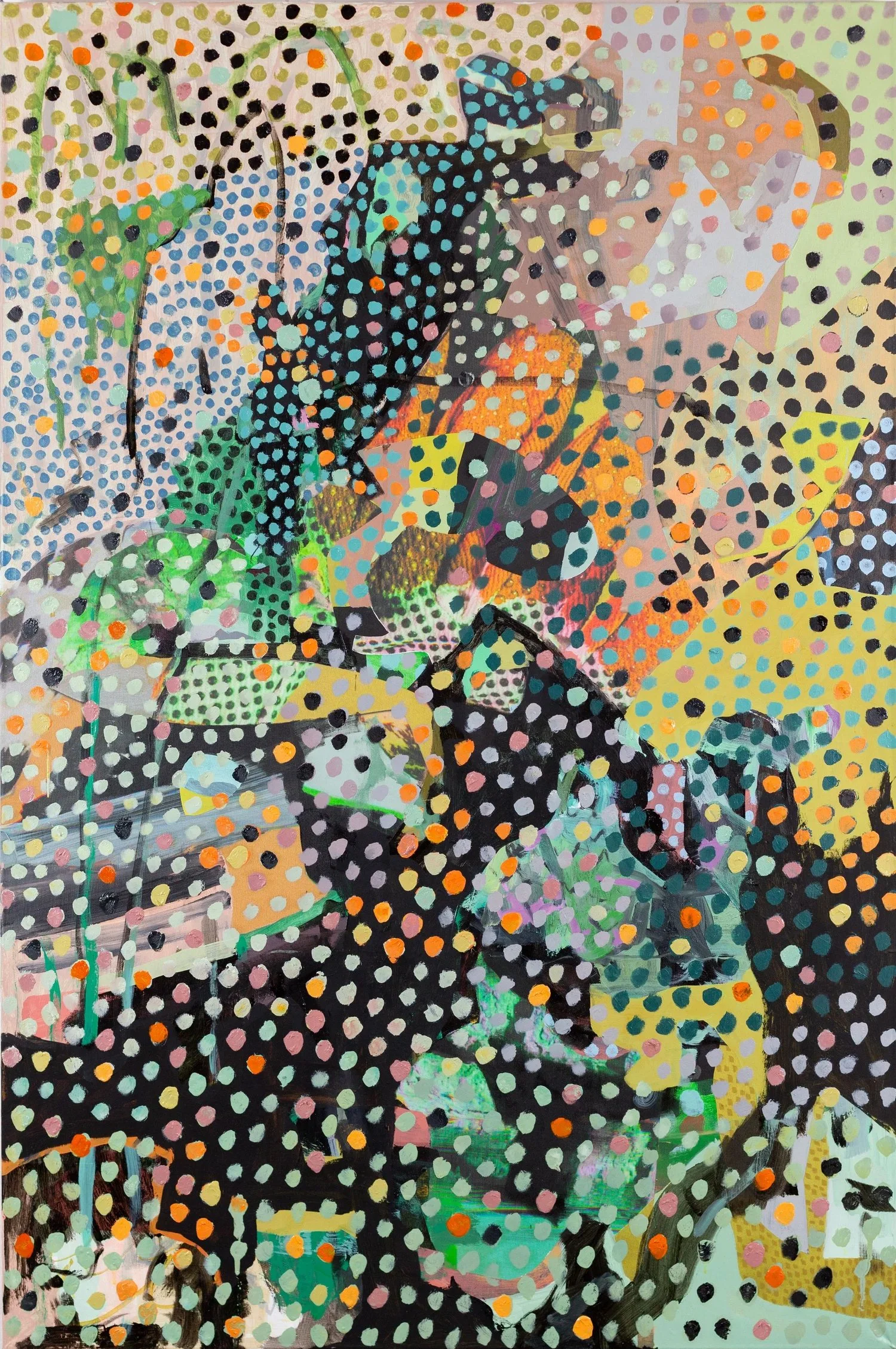
Gloves and Mist, 2026, oil on inkjet printed cotton / linen canvas, 48 x 31”
JM: I love that. I don’t often think about time in that way when I’m making the work, but it’s a gift to hear because it gets to the heart of what I’m trying to do. To simplify it conceptually, I’m invested in creating a sense of multiplicity and simultaneity.
At any moment, wherever we find ourselves, there are cognitive structures at work that help us reduce the complexity of the world. I’m standing on a floor. I’m upright. This is bigger, this is smaller. This is closer, this is farther away. Our brains are constantly constructing a highly structured hallucination that allows us to function in the world. But that can also create the illusion that things are stable, discrete, and have independent forms or realities. In fact, almost anything can dissolve into a multiplicity if you look closely enough or understand more about what’s happening beneath the surface.
In David Haskell’s book about Shakerag Hollow, there are incredible passages where he describes moisture and energy moving through the interior of a tree. We look at a tree and understand it as a single thing, but he describes in detail the different pathways and efficiencies that various species have developed to perform these fundamental processes. All of that activity is pulsing around us constantly, even though we can’t see it.
The same is true of our bodies. We think, “I am this body, I’m this person. There’s another person over there.” We understand ourselves as discrete objects. But each body is also an entire ecosystem of other organisms living within and around it. What appears to be a single, stable thing is actually a whole world of interconnected life.
MS: Yeah. I really like what these mental exercises suggest about being present. Practicing presence often involves temporarily dismantling the hierarchies we rely on to move through the world. As you’re saying, we need those hierarchies to function. I talk to students about this in relation to careful observation. We can’t move through the world equally fascinated by everything we encounter; we’d never get anything done. But we can set aside periods for close observation, and during those moments, those hierarchies can begin to dissolve.
That’s one reason I often think about landscape in this way. It helps me locate myself—where I am and what I’m doing—but my experience of a place rarely has as much to do with the vista as it does with the smaller things that are easy to overlook. Sometimes those details might even seem like distractions from the view, when they’re actually central to how I experience the place.
Your description of converting the studio into a photography space and building small dioramas also caught my attention. When you make those photographs, are you building a library of images for later collages, or does the photographic process function differently within the work?
JM: That’s definitely how it started. Around 2014, I was still working with found imagery, which is something most collage artists either begin with or pass through at some point. There’s something exciting about finding an existing world of images, pulling them out of their original context, and seeing how they graft onto other surfaces. The unexpected relationships that emerge are at the heart of Surrealist collage. Of course, that can also become overly nostalgic, with everyone pulling from the same vintage magazines. But I was interested in what I might call the ontological joy of collage—the transformation that happens when an image is removed from one context and placed into another.
Eventually, I realized that the transformation itself interested me more than the found imagery. I started experimenting with scanners as a way to record and reprint images and build a library. In the process, I would accidentally smear an image or stumble onto effects I hadn’t intended. I began to see the scanner as a kind of automatic Surrealist tool. At first I was feeding it found imagery, but then I started using my own research photographs—images I had never intended to exhibit as finished works.
That made me realize I didn’t actually need found imagery. You could take almost any image, push it through this process, and extract something new from it. The mutation and transmutation produced by the process became more important than the source material. So I began creating a more self-contained image environment in which I produced all the imagery myself. I would print something, scan it, print it again, and scan it again. Gradually, the process became less about building a library and more about generating new images.
Eventually, I narrowed the process into certain parameters that became a series I call Phenotypes. It has always remained experimental, but within that framework I select certain images to formalize as finished, standalone works.
For years, I also printed those images onto canvas as the starting point for my paintings. I worked that way for about eight years. It became another way of extending the logic of collage. Instead of cutting out an image and attaching it to a surface, I would print the image onto the canvas and then use paint almost as if it were another collage element. Every painted gesture had to respond to what was already there: Where does this go? How does it interact with the image underneath it?
The show at TSA right now represents a kind of fulcrum between that process and something new. Some of the work marks the last stage of painting over printed scanner collages, while other paintings are the first I’ve made in perhaps twenty years where I’m putting paint directly onto canvas without a collage element underneath.
I’m trying to figure out how to deploy painting as a vocabulary on its own, but that vocabulary was entirely shaped by collage. I still want the paint to enact the principles of collage, which often means masking, covering, or carving out sections of the image. Many of the paintings begin very freely. If you saw them at an early stage, they might look like generic Abstract Expressionist paintings. From there, I respond to what’s happened by covering, masking, and isolating different areas. It’s essentially collage logic carried out through brushstrokes.
MS: That makes total sense. I know you have a background in photography. I came to photography somewhat accidentally. I was always intimidated by the medium and tended to think of it as something slightly out of reach—that you needed formal training in order to make photographs.
JM: That was true for a long time, and it's no longer the case really., it was, it was never totally true, but it was, it was more true than it is now.
MS: Yeah. Collage was really what catapulted me into photography. As I learned to use a darkroom, develop film, and work with photographic processes, I began to think of photography more as a form of printmaking. That made the medium much more approachable for me.
Photography also opened up my collage practice beyond the found imagery you were talking about. I had struggled with found images for years because they tended to place this filter of vintage color and nostalgia over everything I made. It was difficult to figure out how to break away from that aesthetic because I didn’t necessarily want the work to exist in that realm.
JM: It’s such a thorny trap for anyone working with collage. At some point, you have to either confront that vintage quality or embrace it. One of my favorite collage artists is John Stezaker. His work is deeply invested in vintage imagery, but he transforms it in an almost alchemical way. Still, it’s a real conundrum for collage artists.
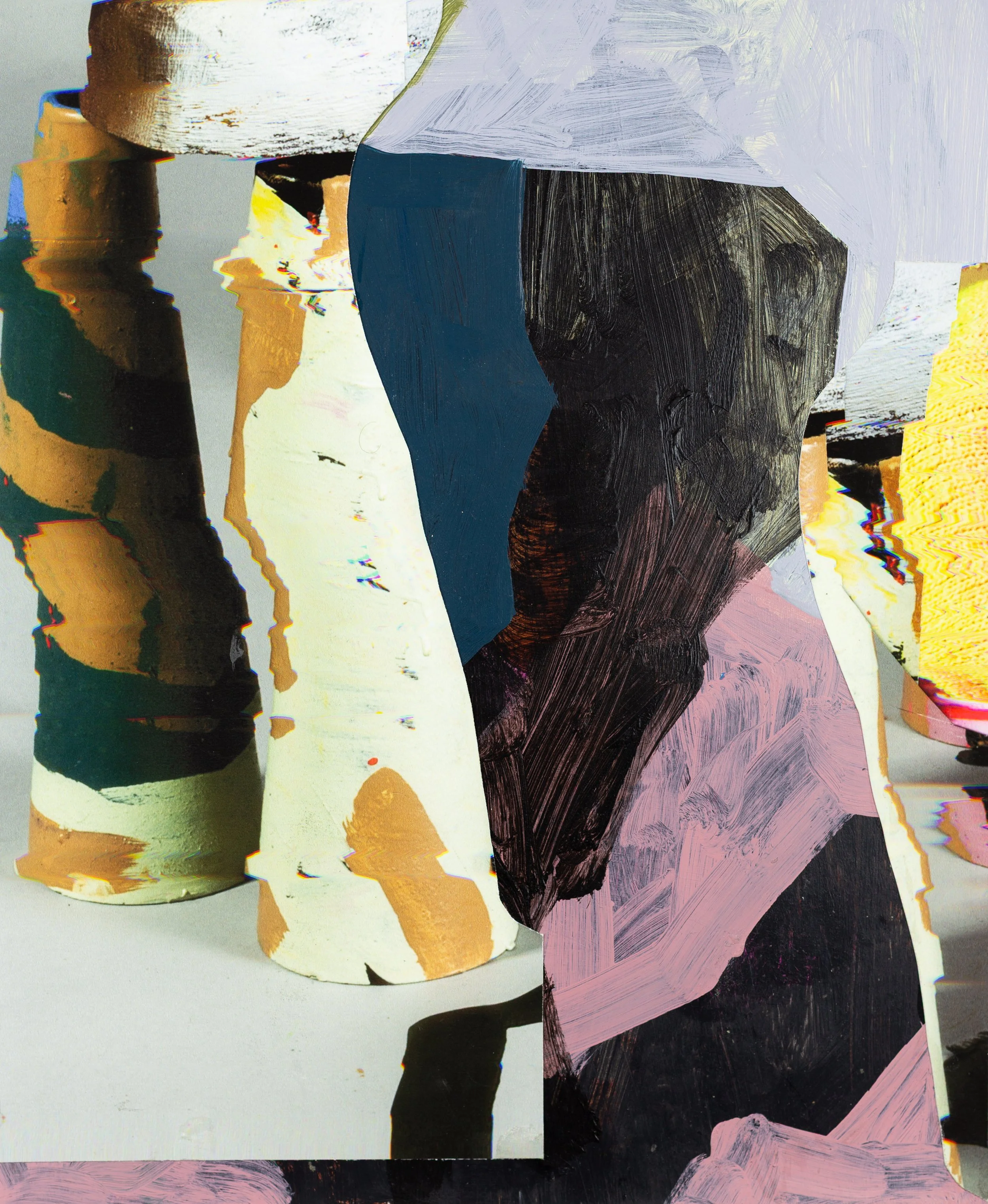
Khi Skarin, 2023, collage and paint on paper, 17 × 14”
MS: It’s interesting that painting has found its way back into the process. I was trained as a painter and identified that way for years, but eventually painting became intimidating to me. Recently, I’ve started making paintings again for the first time in about a decade.
I’ve found it easier to begin with digital collage and then paint halftone patterns over those images. That process creates some distance from the idea that I’m “making a painting.” In fact, I’m not sure I even consider them paintings, despite the fact that they’re made with paint. That ambiguity helps me avoid becoming overly self-conscious about the medium and gives me more freedom in the process.
JM: I relate strongly to that. For about eight years, I thought, “I’ll paint, but only if I’m painting onto an existing image that I’ve made.” Then eventually I pulled the print away and realized, “Oh, I can just paint.”
MS: I’m going through the same thing right now. Similar to your scanner collages, for a long time I wasn’t really making paintings. I was using paint to create textures and patterns, scanning them, and then turning those images into large pigment prints. I would do a little collage work on top of the final print, but eventually I started to miss working on a single surface for an extended period of time.
It’s funny how our studio practices meander along different paths. My studio had gradually become a series of small workstations where I would complete individual parts of a larger process. Eventually, the finished image would come back to me as a pigment print. At a certain point, I realized I missed having a single object in the studio that I could continue working on and developing over time.
JM: Part of what’s been so freeing is that, creatively and conceptually, I’m still excited about what I was doing for years, but the process wasn’t always joyful. I wasn’t always able to find a flow state. It might sound silly or romantic, but making a big-ass painting and deciding where to put a little bit of color is simply more fun. It feels open and free.
Before returning to painting, I went through cycles of asking myself, “How do I want to behave in the studio?” I’d decide to behave like a photographer for a month, then a painter, then a collage artist. I would switch gears and try to figure out where the flow was and what needed to happen within the order of operations. I liked toggling between those different modes, and I still do.
I don’t think I’ll ever reach a point where I simply say, “Okay, time to make another painting.” But right now, I’m enjoying widening things out—sitting with one large image and adding to it gradually until it starts to feel like something alive.
MS: I can relate to that completely. This is basic shop talk, and I think most artists experience some version of it. I’ve noticed in my own practice that if I work with a particular material or process consistently for five or six years, I start to develop expectations around how I’m supposed to use it. That introduces a kind of pressure that can gradually sap the excitement and joy out of the studio because I start worrying about doing something the “right” way, whether it’s painting, photography, or anything else.
At this point, I’ve accepted that my practice will probably always drift into other processes and mediums. I might be working one way for several years and then unexpectedly find myself making screen prints or moving into something entirely different.
Because over a long enough time period, what I've experienced is that my previous expectations about a material, they go away, and then I come back. with a lightheartedness that I didn't have before.
JM: That’s part of the art—or the craft—of being an artist: figuring out the scaffolding of decisions and structures that gets you into the kind of flow you want, where the outcomes are exciting to you. Managing that scaffolding is a craft in itself.
MS: I’m always interested in what artists do outside the studio and how those activities can be both connected to and separate from the artwork they make. With your life as a musician, do you find that music is compartmentalized from the studio, or are there overlapping lessons? Do they scratch the same itch?
JM: It’s strangely difficult to answer because I tend to overlook the most obvious connections. Sometimes someone else will point one out and I’ll think, “Oh yeah, of course those things are connected.”
For me, though, it’s all part of an enmeshed creative world. There are different spaces where I’m trying to enter a creative flow state, and that can operate in different ways. Musically, recording feels most like painting. I’ve done a fair amount of studio recording over the years, but during the pandemic my wife and I put together a modest home recording setup so we could experiment with ideas. I made a record that I released a few years ago, and I’m working intermittently on a few others.
When I’m recording, it feels very similar to painting or collage. In a recording program, you’re looking at layers that you can toggle on and off while trying to build a structure. Is there enough contrast here? Does it need more bass? Does it need something else? My composing process is very collage-like. I’ll throw things at it to see what sticks. Sometimes I’ll add several elements and then remove the thing that started the whole piece and realize I never needed it. When I’m working that way, it feels like the same parts of my brain are lighting up as when I’m painting or making a collage.
Playing pedal steel guitar is different. That feels more like playing basketball. You have to find the rhythm and groove and then surf that wave while it’s happening. You have to remain completely in the moment and try to elegantly connect what you’re hearing with what you’re playing.
It’s about being totally immersed in time. The instrument itself is interesting because it comes from such a specific genre. The pedal steel guitar was developed within country music for very particular musical purposes, so it’s always prone to sounding like country. At the same time, it’s this incredibly open experimental instrument capable of producing an enormous range of sounds.
I love playing with every part of that continuum. I play experimental improvised music where I’m exploring the range of sounds the instrument can produce, but I also have a monthly country band that plays honky-tonk music. That’s one of the happiest nights of my month. Every time, I think, “Yep, I can’t wait to get back here.”
A friend of mine, the painter Duško Petrović, once told me that my scanner-collage process reminded him of playing pedal steel. When I’m making a scanner collage, I place different fragments on the scanner and, as it moves, I’ll keep certain elements still while sliding or bending others.
I had never thought about that connection before, but for someone who doesn’t play pedal steel guitar, it was an incredibly perceptive observation. That’s essentially what a pedal steel does: it keeps certain pitches locked in place while bending the pitches adjacent to them.
MS: That’s a compelling connection—the scanner collage holds certain elements in place while bending others, much like the pedal steel. Thank you for taking the time to talk with me about your work.
JM: Thank you. I appreciate the conversation.