

Suzanne Chamlin

Airport, Afternoon, 2022, Oil on Linen, 9 x 12 inches
Matthew Shelley: Can we start with where you’re from and where you grew up?
Suzanne Chamlin: Sure. I was born in Long Branch, New Jersey. I grew up in Teaneck, New Jersey, just over the George Washington Bridge. My parents divorced when I was three and as a child, my sisters and I visited our father every other weekend who lived at the Jersey Shore.
MS: So you grew up in the greater New York area?
SC: Yes.
MS: Did that mean you had early exposure to the city—that it always felt like home?
SC: Definitely. Growing up, my sister and I both studied music. I studied classical piano for 13 years. As a child, I played by ear before I started formal lessons. My sister was also a musician.
We lived close to New York because my mom wanted that for us. I often took the bus into the city. In high school, I studied piano and voice at the Manhattan School of Music on Saturdays. I would take the bus from our apartment to the George Washington Bridge, then downtown to the school, music was a big part of my upbringing.
MS: That’s interesting. I’m always curious how people find their way into the arts. Did your mom have an interest in classical music, was that something passed down to you through family?
SC: Not really. My father sang a lot—he was a lawyer, but loved music and theatre. He and his brother loved to sing. My sister also studied music, so there was some exposure.
When I was 4 years old I would hear something on TV or in a theater and then go to the piano and play it by ear.
MS: That’s incredible.
SC: My mom worked in a furniture store after the divorce. She didn’t go to college and wasn’t involved in music. But my dad loved singing, and that theatricality definitely had an influence.
MS: I ask because sometimes people grow up in artistic households where creativity is everywhere—galleries, museums, and so on. Others discover it on their own. I didn’t grow up with much exposure to art, so when I found it, it felt like something that belonged to me. It became part of my identity.
I’m always interested in those early experiences. Did your family go to museums like the Met when you were growing up?
SC: Not really. My mom would occasionally take us into the city—usually for something simple, like getting bagels. I remember her stressing about finding parking. We might have gone to the Museum of Natural History once or twice. She worked five or six days a week, and a few evenings, so we didn’t do a lot of cultural outings.
Sometimes we’d celebrate birthdays in the city—maybe go to a Spanish restaurant. But it wasn’t centered around museums or the arts.
My sister was very dedicated to classical guitar, and I relate to what you said about having something that feels like your own. When I got to college, I started drawing, and I really loved it. It felt like something that was mine in the same way.
MS: So your interest in visual art began in college?
SC: Yes.

River Road Preserve, 2023, Oil on Linen, 8 x 10 inches
MS: You weren’t drawing before that?
SC: No, not really. In my first drawing class in college we worked outside drawing from nature and I loved it. I started drawing more in my dorm room.
One professor in college had us drawing from the dioramas at the Museum of Natural History. Barnard was quite academic, and I wanted more studio time and began going to the Art Students League several times a week for open sketch sessions in the evenings.
My college years were a period of exploration. I spent a summer at RISD after my freshman year and then went to Chautauqua for two summers. I was constantly doing art.
Eventually, I did a year-long exchange at Tyler School of Art because Barnard’s studios closed early, and I wanted more time to work. Tyler gave me the freedom to paint intensively. I commuted back to the city to complete a required seminar capstone at Barnard and graduated from there.
At Tyler, I was working on large-scale paintings—six by eight feet—and doing ink wash drawings in the landscape. It was an incredible experience.
MS: That’s fascinating—especially that your first exposure to drawing was outdoors.
SC: Yes.
MS: I often wonder whether our early artistic experiences shape our long-term sensibilities. Maybe we begin with certain instincts, move away from them, and eventually return.
SC: I think that’s true. I remember going to summer camp when I was younger and making an ink drawing of a barn in nature when I was about 14. Even then, I felt drawn to working from observation outdoors.
MS: It’s an interesting idea—that we start in the right place instinctively, explore other paths, and eventually come back.
SC: Exactly.
MS: It also sounds like once you found art, you committed to it very quickly.
SC: I did. What we love is what sustains us. I couldn’t wait to go to painting and drawing classes. That curiosity really pulled me in.
It was also one of the few times my mind felt completely quiet—and it still is. Not every part of my practice feels that way, but when I’m mixing color, there’s a sense of calm.
My upbringing was complicated and sometimes chaotic, and art became a quiet, safe space for me. It was challenging, but that challenge was engaging. When I was working, my worries would fall away. There was something very comforting about it.
More recently, I’ve been deeply focused on color—approaching it almost like a puzzle. I’ve always liked math, and I think that connection is becoming clearer in my work.
I’ve been studying with Judith Reeve, a painter and scholar who is the author of The Color Investigations of Robert Henri, Volumes 1 and 2. Judith also writes a blog called Attentive Equations. She has spent decades researching color and is deeply knowledgeable about the palettes of Denman Ross.
I came across her work while researching Fairfield Porter. Around that time, I was struggling with chroma in my paintings. I found her writing on Ross’s palettes, and it really resonated with me.
Ross developed structured palettes based on color temperature, value, and complementary colors. I’ve used complementary colors more intuitively, but this is giving me a deeper understanding for how to control them.

Painter Hill Road 3, 2023, Oil on Canvas, 10 x 20 inches
MS: That’s fascinating.
SC: I’ve been making color charts—many of them—to internalize these ideas. For example, in one palette, I’m working with cobalt blue and a carefully mixed orange. The challenge is to adjust their values so they match, which is surprisingly difficult.
The mixtures happen within structured relationships—almost like a geometric system—balancing warm and cool colors.
MS: I really admire that. It’s such a beautiful great of systematic study and artistic expression. The charts themselves feel like works of art.
I’ve been telling my students that the work they do off the canvas—like palette preparation—is just as important as what happens on the canvas. There’s this tendency to think that the final image is all that matters.
But cleaning a brush, mixing color—these are all integral to the act of painting.
SC: Absolutely.
MS: Those charts embody that idea. They reflect thought, exploration, and the labor of understanding something deeply.
SC: Thank you. I think that’s especially important now. We live in such an image-driven culture, and students often equate painting with subject matter or imagery.
I think we’re living in a time where, as painters—and really as artists and educators—we face a particular challenge. Our culture has become increasingly image-driven, and so students often come to painting with that mindset.
When many students think of painting, they equate it with subject matter—the idea, the image. But painting has so much to do with the application of paint, the physicality of it, the feeling of the pigments. One reason I make so many color charts is something Judith Reeve once said, which I really believe: the more we handle color and pigments, the more familiar they become—we internalize them.
For me, that process has always been comforting. I grew up playing scales—daily, for years—as a kind of warm-up. So the idea of just jumping in and making a painting always felt daunting. You’re standing in front of a subject, the light is changing, and it’s just you and this overwhelming situation.
Now my process is much more rotational. I spend a lot of time making charts, mixing paint, even tubing my own colors, and then I go outside to paint. I probably spend as much time preparing—making charts and organizing materials—as I do actually working in the landscape.
MS: I think a crucial part of studio practice is being able to settle your mind enough to embrace all the non-product-driven aspects of it. The exhibited work will come, but only if you have the patience to trust the process and commit to the labor itself, rather than focusing on production.
You earned your MFA at Yale, right?
SC: Yes. After graduating from college, I taught at the Spence School—an all-girls school on the Upper East Side—for two years.
I was part of a teaching fellowship program run by Henry Drury at Princeton and funded by the Dodge Foundation. It brought together recent graduates and mentored them in teaching. We met every Wednesday night—teachers from private schools across New York—to discuss the challenges of teaching. I was the only art teacher, as I recall
That was my first job. I spent that summer applying to schools across the city. Eventually, I joined the Inter-School Teaching Fellowship, which was a full-time position with weekly meetings.
After the first year, Spence kept me on. They had a great philosophy: artists should only teach two-and-a-half days a week so they can maintain their studio practice. During my second year at Spence I applied to Yale and then went to graduate school.
MS: What was the environment at Yale like at that time? Was there a strong emphasis on painting?
SC: There definitely was. We had a wide range of faculty—many visiting critics coming into the studios and engaging with our work. It was assumed that we already had a studio practice and some sense of direction.
For me, that was challenging. I didn’t have much formal foundation. I had jumped into senior painting at Tyler, so figuring out subject matter was difficult. The summer before Yale, I attended a residency at the Millay Colony and also had a show at the Fine Arts Museum of Long Island.
At that point, I was making large paintings—some from landscape observation, others from imagination. Those were the works I applied to Yale with. In New York, I had a small studio apartment on 102nd Street, with a large movable wall so I could paint on a bigger scale. I was also doing drawings in Riverside Park.
When I got to Yale, I continued exploring that divide—working from observation in drawing and from imagination in painting. But yes, painting was very present. It felt like everyone was painting.
MS: And what year was that?
SC: 1987.
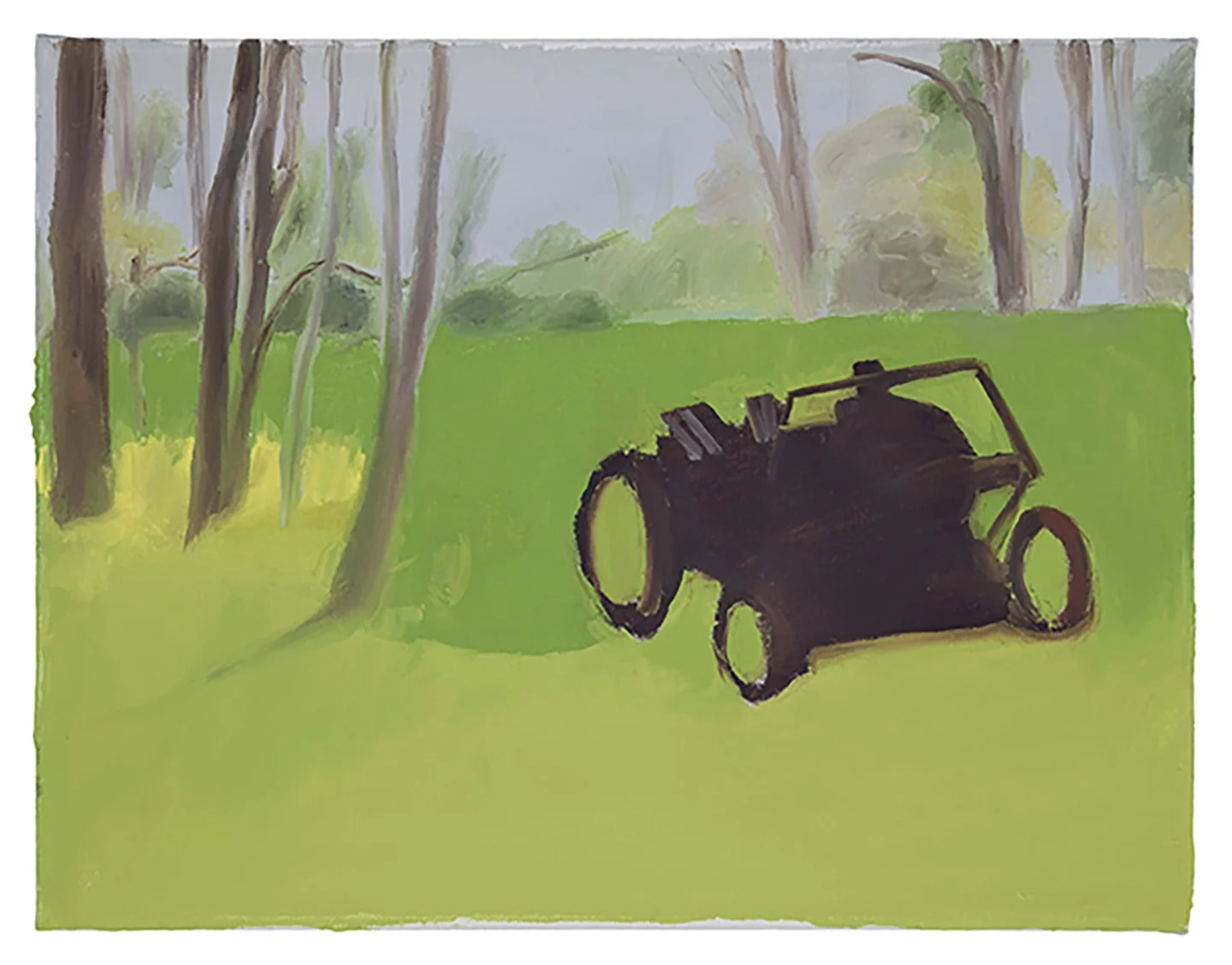
Midday, 2015, Oil on Canvas, 14 x 18 inches
MS: My understanding is that painting wasn’t the dominant focus in the late ’80s art world. Did you feel that at Yale?
SC: There were a few artists working with projection and other media, but painting was definitely central. There was a strong emphasis on engaging with the material—moving paint around and discovering subject through that process.
What stood out most was the diversity. Every student’s work was completely different, and the faculty brought a wide range of perspectives. It wasn’t prescriptive at all, which I really appreciated. It reinforced the idea that every artist thinks and works differently—both conceptually and physically.
Now, I find myself returning to foundational ideas—complementary colors, value relationships—but I’m very grateful for that early exposure to such a broad range of approaches.
MS: You hear about certain schools favoring abstraction, or rejecting painting altogether in favor of conceptual work. It sounds like Yale was more balanced.
SC: It really was. Everyone had their own studio, and no two artists were working in similar ways.
I’ve always been fascinated by more traditional academies, where there’s a shared method—like figure drawing that leads to a consistent look. You get a bit of that at places like the Art Students League.
MS: I sometimes envy those environments because progress feels more measurable. Outside of that structure, it’s hard to gauge improvement. Looking back at my own work over 15 years, it’s difficult to say whether I’ve progressed—it depends on how you measure it.
SC: I completely understand that. I feel the same way—that desire for something more concrete, some visible measure of growth.
MS: You mentioned painting from imagination, especially in these larger works. Do those paintings still feel rooted in reality? Are you inventing landscapes, but ones that feel more ordinary? Like imaginary landscapes which aren’t necessarily fantastical?
SC: I admire the skills it takes to create something fully fantastical. My work is more about responding to color—what I see—and then pushing the paint around. I can send you some images so you can get a sense of what I mean.
I remember one painting I did—just under six by eight feet—called Marsh. It was very thickly painted. I kept moving the paint around until the tones felt like they created a believable space, at least to my eye. I’ve always been interested in the relationship between observation and imagination.
When I go outside and paint landscapes with ink and wash, I sit in one place—like at the Virginia Center for the Creative Arts. I went there many times, maybe seven, and I’d just sit in the Blue Ridge Mountains and paint. At that time, I thought of painting as something more tied to imagination, while ink and wash was about observation.
Even though I never translated those drawings directly into large paintings, they informed my sense of light. The work wasn’t surreal, and there wasn’t much imagery—it was more about space, derived through the movement of paint.
Later, around 2000, I started working outdoors again—painting at the Brooklyn Botanic Garden, especially the lily pond. I had done some of that in graduate school, but earlier on I was more focused on painting from imagination.
MS: That’s very relatable. I approach landscapes similarly—they’re often hybrids of different places. To a viewer, they might not seem invented, because all the elements come from observation. But I’m not working from a reference image, so they’re still imagined.
Even so, the structure—the figure-ground relationships—remains grounded in reality. I was curious about your process because sometimes, in these conversations, I learn things about artists’ work that I wouldn’t have expected—like discovering someone worked as an abstract expressionist before becoming a highly controlled representational painter.
SC: That makes sense. For me, painting has always been about handling of the paint—finding the subject and imagery through color and its application.
Recently, I worked on some snow paintings. There was one based on a mound of snow, it melted before I could finished. So I’ve been trying to complete it from memory, and it doesn’t feel the same. But it made me realize that when I used to work from imagination, I wasn’t trying to recall or reinterpret what I’d seen. I was inside the painting, asking whether it felt believable—working through gesture, palette knife, brush, and mark-making.
I think some of that comes from ideas rooted in abstract expressionism.
MS: This is a bit of a tangent, but I think you’ll relate. I was talking to a photographer who asked whether remembering a place can be more powerful than actually being there.
And I think it can be. When I’m in a place, I’m so focused on taking everything in that it becomes almost overwhelming. But later, in the studio, reflecting on it feels more pleasurable. Of course, I’m probably inventing parts of the memory—adding things that weren’t really there.
SC: That’s fascinating. It’s like seeing, memory, and imagination are all intertwined. Even when we’re physically present, we’re still interpreting—almost imagining into the experience.
Being in a place is very different from remembering it. Memory condenses everything into something more singular, more defined—though I’m not sure I’m saying that quite right.
MS: No, that makes perfect sense. There’s a place that’s really important to me—Palmer Snowfield on Mount Hood. I’ve been going there since I was a teenager. Sometimes, when I’m actually there, it feels a bit underwhelming. But the memories—the light, the emotions—become a kind of touchstone when I’m back in the studio.
What you said earlier about imagination is interesting. We tend to associate it with the fantastical, but it can also be about very subtle, ordinary experiences—like recalling a landscape or an interior. Even those quiet, mundane details are acts of imagination.
SC: That’s a great point. It might even connect to something more primal—like survival. When we’re safe and comfortable, like in a studio, we can drift into that kind of reflective state.
But when you’re actually out in a place—I would imagine like in the snow on Mount Hood—there’s still a part of you that’s alert. Even as humans, we’re still animals. We’re aware of the cold, the weather, and potential risks, and that awareness shapes how we experience things.
MS: Exactly. I could talk about this for hours. I wanted to ask—have there been times, at Yale or elsewhere, when you moved outside of painting? Or has your work always stayed within painting and drawing?

Yellow House, 2023, Oil on Linen, 8 x 10 inches
SC: It’s always been painting and drawing. I haven’t really worked outside of that, though the subject matter has shifted over time. There have definitely been periods where I didn’t know what to paint—or even how to spend my studio time.
A lot of that had to do with life circumstances. Before teaching full-time at Fairfield, I was working part-time at multiple places in New York, commuting constantly. Balancing work and studio time was always a challenge.
There were times I was teaching six days a week—traveling between different schools—and by the time Sunday came, I just needed to rest and take care of basic things. During those periods, it felt like a creative dry spell.
MS: That’s actually really important to talk about. It’s part of the reality of being an artist—how we support ourselves while continuing to make work.
I always tell students that they don’t need to spend forty hours a week in the studio to be a “real” artist. Whether it’s a few hours at a kitchen table, or making art after a day job, it still counts.
There’s this idea that if you’re not doing something professionally—if you’re not getting paid—it’s not valid. I strongly disagree with that, especially when it comes to art.
Lately, I’ve been feeling something similar to what you described. My life isn’t especially complicated, but even finding a few quiet minutes to work has been difficult. It feels like there’s no room to think.
SC: I completely understand. I think the digital world—the constant access, all the time—plays a big role. I struggle with it too, figuring out how to manage that. It feels like a reflection of the times, but also raises the question of how we choose to respond to it.
MS: I’ve been realizing that I have to start protecting my studio time again. I used to be better about that. I need to start blocking off portions of the day when I’m unreachable. It seems like the current environment doesn’t allow people to do that. We are expected to always be within reach and constantly responding.
I need time to think—to be able to read an entire chapter of a book without the urge to check my email.
So, this question may or may not apply to you, but I’m curious: have there been stretches in your studio practice—maybe three or four years at a time—when you felt like you were on the right path, only to later realize it was more of a tangent?
I’ve had periods like that. For example, I spent four or five years trying to push my work toward what I thought aligned more closely with contemporary art discourse. But looking back, I realize I was responding to external pressures rather than following my own genuine interests.
Have you experienced something similar—times when you felt you unintentionally went off track?
SC: Oh, absolutely. I think the whole journey is really about following your curiosities.
I can think of a specific example. You saw the color charts I made—the ones in the FUAM, Bellarmine Gallery show. In 2012 and 2013, during a sabbatical, I took a color workshop at Grand Central Academy and decided to chart every pigment I owned—every tube of paint—just to really understand what I had.
In retrospect, it was a valuable exercise. You can’t always tell what a color truly looks like straight from the tube, especially without seeing it in relation to other colors. So I made these charts—they almost looked like piano keys.
But I had accumulated a lot of paint over time, and now I realize I’ve barely used most of those colors. I’d say I use maybe 3% of them regularly. So I sometimes wonder if spending months charting every pigment was a bit of a detour.
That said, it did lead to the next body of work, where I explored value more closely.
More broadly, I tend to follow what interests me. For example, lately, I’ve been asking simple questions like: can I accurately capture the color of a tree’s shadow on the ground at a specific moment—knowing that it’s constantly changing?
Sometimes I think I get caught up in the idea of wanting to paint more realistically, rather than simply accepting who I am and staying true to my own sensibilities. But at the same time, I’m genuinely interested in the fundamentals—light, shadow, and the underlying structure of things.
MS: Was there a moment in your development when color really became the emphasis it is in your work now? If I had to distill what I know about your work into a sentence or two, color would absolutely be central—among other things. Has it always been a primary motivator?
SC: I think it was actually a struggle for me. Color is tied to what you’re painting, and in my early 20’s I started making large, colorful paintings inspired partly by fashion and partly by imagination.
I felt a need to define what I was going to paint, and fashion became a way in. I’ve always loved fashion, so I began making these big, colorful works.
Back then, color was more intuitive—almost like bursts. But over the past 12–15 years, my interest has shifted toward understanding how color actually functions—how I can use it more deliberately and deeply.
Even if that means producing less, I’ve wanted to develop a more sustained engagement with color. In the past, I’d put down a bright color and feel like the painting was finished too quickly. I’ve struggled for years with staying involved in a painting longer—especially in oil—so that it reflects a deeper understanding of light, shadow, and value.
Another challenge is that I can be influenced by outside feedback. Someone might come into my studio and say, “That looks great—don’t touch it,” and I’ll listen. Sometimes too much. Then I stop before I’ve really gone as far as I want.
MS: I relate to that completely. I might be one of the most impressionable artists out there. I’ll go to a show, feel inspired, and come back to the studio ready to emulate what I’ve seen. Sometimes that’s productive, but other times it leads me off course.
For example, I might see work dealing with current events. Even if I respect it, that’s not necessarily my language. But I’ll still try to incorporate those ideas into my work, just because I was impressed. Those can become destructive tangents—I forget that appreciating something doesn’t mean it aligns with what I authentically make.

Autumn Afternoon, 2023, Oil on Canvas, 14 x 18 inches
SC: That makes sense, but I also think there’s something positive in that. I’m thinking of Hans Hofmann, who talked about empathy being essential for an artist—having empathy for your subject.
Artists are like sponges. We absorb what we see when we’re open to it. There’s something really valuable about that—about appreciating something, internalizing it, and even trying to emulate it. I think we’re all influenced by what we see.
MS: Yes, absolutely. I think that when you see something and feel compelled to recreate or participate in it, that impulse is what draws people into making art in the first place.
SC: It’s a way of connecting. You see something, and then you want to experience it more deeply—almost like a kind of reverie. I understand what you’re saying about the risks, but I do think it can be positive too.
MS: I think Vija Celmins once suggested that drawing or painting something is a way of possessing it. My relationship to place is deeply tied to image-making—drawing, painting, photography. I can’t really imagine experiencing a place fully without translating it into an image, or thinking about how it might be distilled into one.
To return to color in your work—if this doesn’t make sense, feel free to say so—but I think of your use of color as multifaceted . It’s not purely observational, but it’s not entirely invented either.
On one hand, there’s a close attention to observation—like studying the exact color of a shadow. On the other, there’s a willingness to invent—to treat color as a design element, something autonomous within the painting.
So it feels like you’re balancing observation with invention—color as both something seen and something constructed.
SC: Yes, that describes my process well. I’m aware that I’m making an object—a painting as a thing in itself. That’s part of why I’m drawn to color charts. They allow me to focus purely on relationships between colors, without distraction.
Color is always relative. And when I go outside to work from nature, my aspiration now—more than it used to be—is to create a feeling…
I try to get close to what I’m seeing, but what you’re describing is also just who I am as a painter. Part of what I do is invented, and part of it comes directly from observation. I’m not a realist, but I’m also not working purely from imagination.
MS: Right—and it’s subjective. Your interpretation of a shadow color and a student’s interpretation can both be valid. That’s part of what makes it interesting.
SC: Totally.
MS: When I think about color in my own work, it’s almost never purely observational. It’s more about placing the color that feels like it belongs. In your work, I sense a tension between those two approaches. On one hand, there’s an effort to stay true to your sensory experience. On the other, there are moments where you choose a color because it helps resolve the painting.
SC: Yes, exactly. And the conditions of working outside play a huge role too. The light is constantly changing, especially with the weather. I’ve been painting outside all winter—even in the snow—which I love, because I enjoy having something in front of me to interpret. But the conditions can be chaotic. I use paper towels a lot, and in the winter they were literally blowing away in the wind.
So there’s a lot happening at once. I’m trying to mix the colors I see, but more and more I’m thinking about the light itself. That’s becoming more important than the exact color. What I really want is for the place to feel like a place.
That’s part of why I got so involved in color charts and classes. With the huge range of pigments available today, it’s actually very difficult to narrow things down. Even if I limit myself to just a few pigments—say, three primaries and a couple others—the range of possible colors is still enormous. I’m really interested in how to reduce those possibilities and make decisions within that abundance.
MS: That makes sense. I don’t want to take up too much of your afternoon, but one thing I’m especially interested in is time. It feels very central to your work. You’re dealing with changing light, shifting conditions, and also returning to the same place over and over. The paintings start to feel like a record of multiple experiences layered into one.
There’s a kind of quiet resonance—like you’re not depicting a single moment, but something accumulated over time. I’m curious how you think about that.
SC: That’s a really interesting observation. Time is actually a huge challenge for me. Not only does the light change throughout the day, but the weather changes, and then the seasons change. I have many paintings in my studio that I have to return to months later because the conditions have shifted.
Lately I’ve also been questioning my attachment to working on-site. At some point I became convinced I work better outside, even though I didn’t always work that way. For example, I started a snow painting I couldn’t finish because the snow disappeared. That made me wonder: could I continue something like that in the studio, relying more on memory and my understanding of light?
Time is something I think about a lot. I keep records—dates, times, even when I mix paint. Sometimes I’ll return to a painting fifty times and still not resolve it. Other times, I’ll work for an hour and feel completely satisfied.
MS: I can definitely relate to that. Sometimes you just connect with something and it’s done. Other times, you can spend years on an idea that never quite resolves itself.
SC: Exactly. It comes back to trusting the process. Not everything has to resolve into a finished piece. In fact, the paintings I struggle with the most are often the ones I learn the most from. And then there are others that come together quickly.
MS: Yeah, that’s a very familiar experience. I’m also really interested in artists for whom time plays a major role. There’s something in your work that suggests duration and repetition, even if it’s hard to fully articulate.
I also wanted to ask about space. Some of my favorite moments in your paintings are where the figure and ground begin to flatten. Do you think about how far you want to push that? How important is believable space to you?

Window Study Summer, 2023, Oil on Canvas, 8 x 10 inches
SC: I do love the frontal quality of painters like Rothko—the idea that it’s color and surface. I’m working on being more intentional about space as a focus on color relationships and tone.
Lately, though, I’ve been trying to pay more attention to the foreground. I’m interested now in creating more spatial depth, especially in the foreground.
Often when I’m outside, I’m drawn to what’s in the distance, so the upper part of the canvas gets more attention. The foreground ends up feeling vertical rather than receding into space. That’s something I’m actively trying to address.
MS: That interplay between flatness and depth is really compelling. I love those moments in painting where you can read a surface both as a spatial plane and as a flat field of color at the same time. That tension is really powerful, and it’s something I really appreciate in your work.
I was curious whether you ever experimented with color field painting? Did you ever make paintings where the sense of space starts to disappear completely? I guess another way to put it is: have there been periods in your studio practice where representation felt like it was vanishing entirely?
SC: Some of the larger paintings I’ve done—one called April—don’t feel representational to me. It just feels like color. I painted it in March, thinking about April coming, which is where we are now.
I think a lot about visual hierarchy—what we actually see first. Is it color, shape, light? For me, it’s color. That’s what I register first.
I learned perspective relatively late. I did some perspective drawing in college, but I never fully internalized it. So my drawings have always been based more on value—light and dark. That’s really where my mind lives. I’m also very drawn to geometry and shape, but I experience what I see primarily through color and value.
That said, I’m working on developing more form—trying to understand how light and color can work with shape to create a stronger sense of structure.
MS: That makes sense. One of the great things about talking with artists is that everyone brings their own studio concerns into how they look at work. Spatial relationships are kind of an obsession for me, so I see everything through that lens. Often, what I respond to most in an image reflects what I’m already thinking about.
SC: Right—and I think spatial relationships are fundamental. Ultimately, we’re all dealing with how to transform a flat surface into a sense of space. Whether it’s two-dimensional or suggesting more dimensions, that’s the core challenge for anyone making images.
For me, a painting works when the space feels believable—not necessarily the color or the subject, but something about the space suggests a place.
MS: I relate to that. I don’t think I could make work that’s completely devoid of dimensional space. I need some sense of depth for moments of flatness to feel meaningful.
Not that I can’t appreciate flatness in other artists’ work—like color field painters. Even in a Rothko, I still perceive space moving back into the painting. But in my own process, I need something to push against so that those flat moments feel rewarding.
[…]
When we look at images, they can evoke all kinds of senses. I sometimes think about sound in a painting—even though it’s a silent medium. In your work, I usually sense quiet and stillness. So I’m curious: how do you think about those qualities?
SC: Sound is very important to me—I love music. I almost always have something playing in my head. Lately it’s been Erik Satie’s Gymnopédie No. 1. I tend to listen to the same piece over and over for long periods.
But recently, I’ve also been experimenting with working in silence. I’ve noticed a difference in my concentration when I’m not listening to music. There’s a kind of mental quiet that I can access more easily.
That said, even without music playing, there’s usually still something in my head. And when I’m mixing color, I do think in terms of harmony. Certain combinations feel exciting—like last night when I was working with blue and orange. There’s a kind of resonance there.
MS: That makes sense. I sometimes compare color mixing to the graphic equalizers on stereos—adjusting one element affects everything else. Each color decision requires a kind of balance across the whole painting.
SC: Yes, exactly. My interest in color is deeply connected to my interest in music. Both are complex systems—how notes relate to each other, how chords work. It reminds me of studying music theory when I was younger.
I’m very interested in the question of why—why something works or doesn’t. When a painting isn’t working, I want to understand what’s happening. Sometimes I’ll turn it upside down to see it more abstractly and diagnose the problem.
There have been painters who’ve drawn connections between color and music, and I’m interested to learn more about “color chords”, through Judith’s book and teachings. I’m excited to learn more about that—how combinations of colors can function similarly to musical harmonies.
I’ll show you one more thing that relates to this.
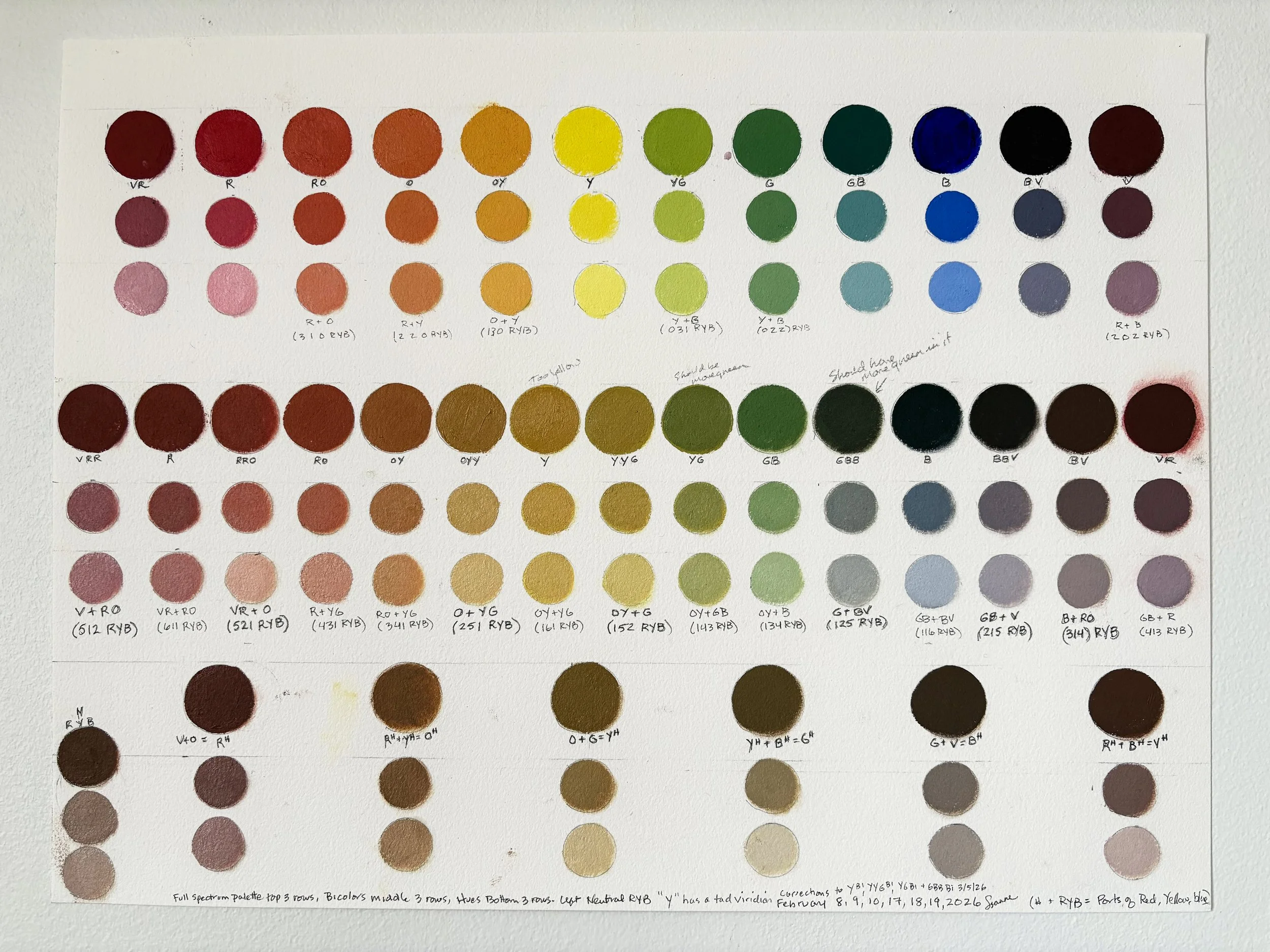
Bi-Color Chart, Suzanne Chamlin, The Color Investigations of Robert Henri by Judith Reeve , 2026
MS: Wow that’s great. So, she was talking to you about chords in color?
SC: Yes—something I’m going to learn through her book The Color Investigations of Robert Henri. I have it right here. And I also have a copy of Denman Ross’s palettes from The Painter’s Palette.
MS: Yeah.
SC: She goes through color chords in that book. I’ve only glanced at it so far, but I’m planning to study it more closely. Over the past few weeks, I’ve been working on this chart. I got interested in it after meeting Judith over Zoom—we’ve been meeting regularly. This is a full-spectrum palette, running from red-violet to blue-violet, with yellow in between. The second chart shows bi-colors.
All of these colors are mixtures, Judith Reeve describes in her book that Robert Henri primarily worked with bi-colors that he and H.G. Maratta developed. The neutrals are down here. What’s interesting is that these bi-colors aren’t made from complementary colors. For example, yellow is created from orange-yellow and yellow-green.
MS: I was noticing that—it’s almost the opposite of how I usually think about the color wheel. Instead of becoming more muted as colors mix, they seem to become more saturated and intense as they move toward each other. Or maybe I’m misunderstanding.
SC: Yes, that’s a good observation. When I started studying with Judith Reeve, I initially came to her because I wanted to understand Denman Ross. She asked if I had worked with a full-spectrum palette, and I hadn’t. She explained that it includes all transitions—red-violet to red, red-orange to orange, orange-yellow to yellow, and so on through the entire spectrum.
The top row here shows the full spectrum, and I added white to create the variations below. I learned from Judith that Robert Henri tended to work more bi-colors than the fully saturated colors .
What’s interesting is that I’ve actually made this chart twice. The first time, I misunderstood the bi-colors—I thought I was just expanding the spectrum, so I created multiple variations of red-orange instead. I ended up redoing the whole thing.
When Judith and I reviewed it together, she noticed that my yellows and greens weren’t shifting enough toward green—they felt too yellow. At first, I thought I had to start over, but she suggested simply correcting those areas and then making another chart later. I really liked that idea of correction. It reminded me of something like math homework—going back and fixing something. I hadn’t thought about that approach in a long time, and it excited me.
MS: Yeah, I relate to that. When I teach perspective, I tell students it’s one of the few moments in art where you can double-check your work—where something is either right or wrong. In painting, corrections are usually much more ambiguous, so it’s hard to know if you’re actually improving something.
That’s one thing I really admire about your practice—your approach to color feels very systematic, almost scientific. Not everything we do in the studio has to be about producing a finished piece, and your color charts, while beautiful on their own, are really about investigation and understanding.
SC: Thank you. Sometimes I just have to trust that all the time I spend on this will eventually influence my work. I co-teach a course with John Miecznikowski through the Honors program called Understanding Color through Chemistry and Painting which is also shaping how I think about it—even though I don’t fully understand the science, I think I’m drawn to this methodical approach, I wasn’t very systematic in my studio practice before.
Understanding color more deeply feels important to me. I think that greater understanding helps me use it more intentionally.
MS: That makes sense. It’s something I really admire—it makes me reflect on my own practice. I wonder if I spend enough time truly trying to understand things, rather than just producing work for exhibitions.
There’s always a point where what I’m trying to explore becomes secondary to making the piece feel finished or presentable. And while I don’t always regret that, those pressures can override the opportunity to really learn from the work.
SC: Yes, exactly. We’re part of a larger artistic community, and there’s always that balance—making work and showing it. Sometimes I’ll spend hours late at night just working on these charts. I have many of them.
I do think they’re helping me develop a greater sensitivity to color. I often compare it to music—you practice constantly, but the result is ephemeral. Painting, on the other hand, produces a physical object. Because my early life was so focused on practice, I think I now approach painting more as a form of ongoing practice rather than just producing finished works.
MS: That’s a really healthy perspective. When I’m preparing for a show, those periods are often less productive creatively because I become too focused on the end result. In contrast, the most meaningful work I’ve made has often come from play, boredom, or working without a clear agenda.
That’s why I appreciate your approach—it’s structured and academic, but also driven by a sincere desire to understand something. That’s rare.
SC: Thank you. I also think about the pressures artists face—to perform, to produce. It’s different from, say, scientists, who are often driven by discovery—finding something new or contributing to knowledge. I try to remind myself that discovery is important to me too, even if it’s not always obvious what the outcome will be.
VOLUME: Thank you to Suzanne Chamlin for taking the time to speak about her work. To see more of Suzanne’s work visit her website here, or visit her instagram @suzannechamlin